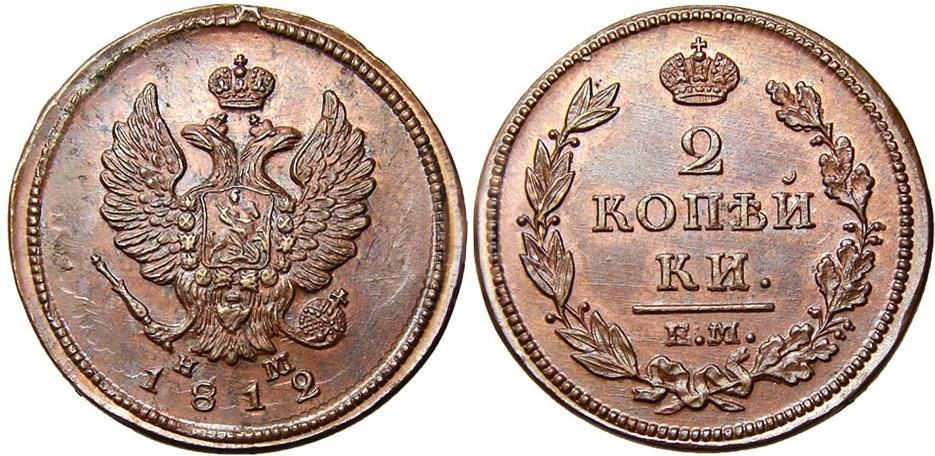

General Overview of the 2 Kopek Coin of 1812
The subject of this review is a 2 kopek copper coin from 1812, issued during the reign of Alexander I. This particular specimen is distinguished by its excellent, so-called 'cabinet' preservation. The coin's surface, or field, is completely glossy, with no signs of mechanical cleaning or harsh interference.
The coin is covered with a smooth, noble golden-chocolate patina that has formed naturally over many years. The reverse features the letters 'E.M.' and 'K.M.', indicating the Yekaterinburg Mint.
The Coin's Obverse: The 'Cabbage' Eagle and the Initials N.M.
The obverse of the coin depicts a double-headed eagle that has fully preserved all its fine details, including the crowns, wings, and the image of Saint George the Victorious on the shield. This type of eagle is known in numismatic circles as the 'cabbage' eagle.
Below the eagle, the year of mintage '1812' and the mintmaster's initials 'N.M.' — Nikolai Mundt — are indicated. The coin has a smooth, glossy luster, and the patina on the obverse is described as 'oily,' which emphasizes its quality and depth.
The Reverse and Unique Patina
On the reverse of the coin, in addition to the denomination and mint marks, remnants of the original mint luster can be observed. These areas with a metallic sheen are visible on the feathers of the wreath beneath the layer of cabinet patina. This indicates that the coin was struck with well-prepared dies and saw almost no circulation.
The patina on the coin is uneven but very beautiful. In the central part, it has a reddish hue, which transitions to a brownish-gold and a deep chocolate color towards the edges. This distribution of patina gives the coin a special aesthetic value.
'Queen of the Fields': History and Mintage
| Characteristic | Value |
| Weight | 13.7 g |
| Diameter | 29 mm |
| Edge | Smooth |
| Monetary Standard | 24 rubles from a pood of copper |
Coins of this type, minted from 1810 to 1830, were nicknamed the 'queen of the fields' or 'field coin' by the common people and treasure hunters. This is due to their extreme commonness. This coin is the most frequent find for those using a metal detector.
The year 1812 was a record-breaker in terms of production volume. The mintage of the 2 kopek 1812 coin with the initials N.M. reached 132,850,000 pieces. This is the largest mintage for any single denomination coin in the entire history of Tsarist Russia. The year of issue coincides with the Patriotic War of 1812.
Varieties and Minting Features
2 kopek coins of this period were issued under two emperors—Alexander I and Nicholas I. They have numerous varieties, which makes them an interesting object for collection.
- [object Object]
- [object Object]
- [object Object]
It was under Alexander I that mintmasters' initials began to be regularly indicated on copper coins.
The Philosophy of Collecting
For a numismatist, quality always surpasses quantity. It is better to have a small number of coins in excellent condition in a collection than albums filled with low-quality specimens.
- [object Object]
- [object Object]
- [object Object]
