
What Determines the Value of a Tsarist Copper Coin?
| Condition Grade | Description |
| Good | The coin has been in circulation, shows signs of wear, but the main details of the relief are distinguishable. |
| Excellent | The coin was in circulation for a short time, has a good relief and minimal abrasions. |
| Superb | The coin was practically not in circulation, retains its mint luster and all design details. |
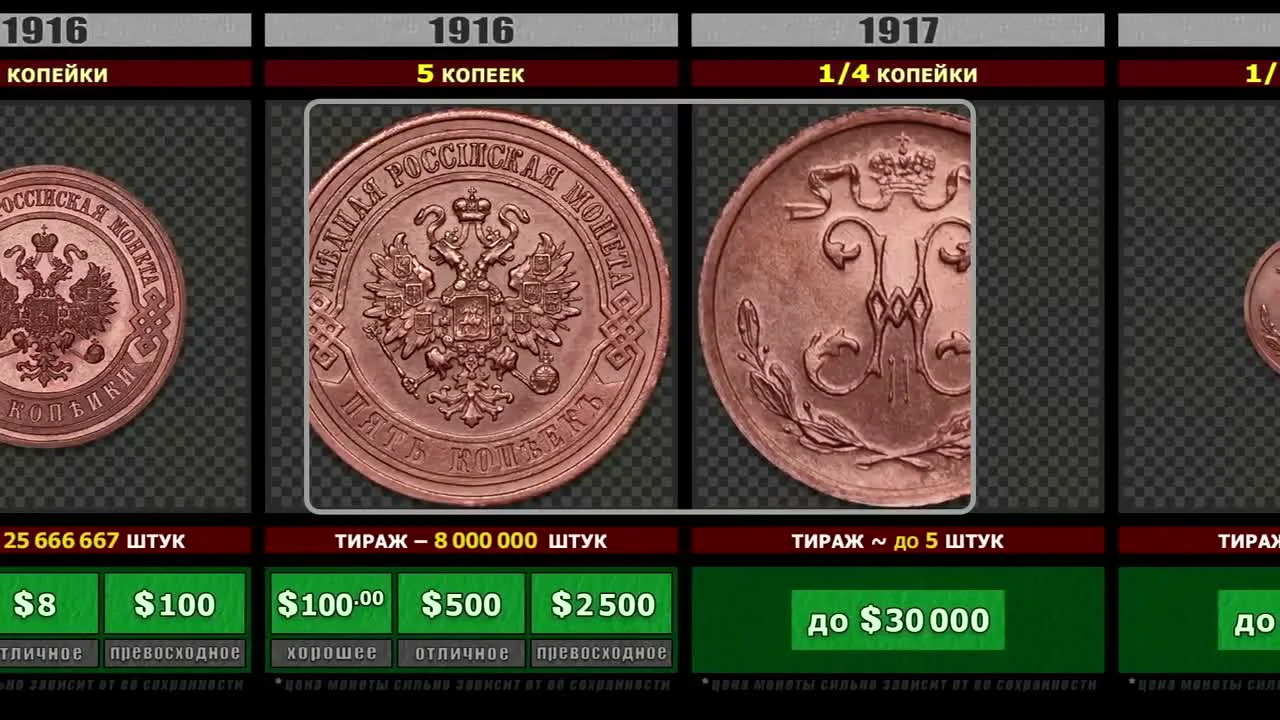
When evaluating copper coins from the time of Nicholas II, several key factors must be considered. The main one is condition. The price is highly dependent on the coin's state, and specimens in superb condition can be worth 10 to 100 times more than coins in good condition.
Collectors should be wary of cheap counterfeits and not be intimidated by the real prices of genuine coins. Careful inspection and an understanding of condition grades are fundamental to proper valuation. In this review, prices are provided for three main condition grades.
Early Period (1894–1898): From Mass-Produced to Extremely Rare
| Coin | Year | Mintage | Price (Good) | Price (Excellent) | Price (Superb) |
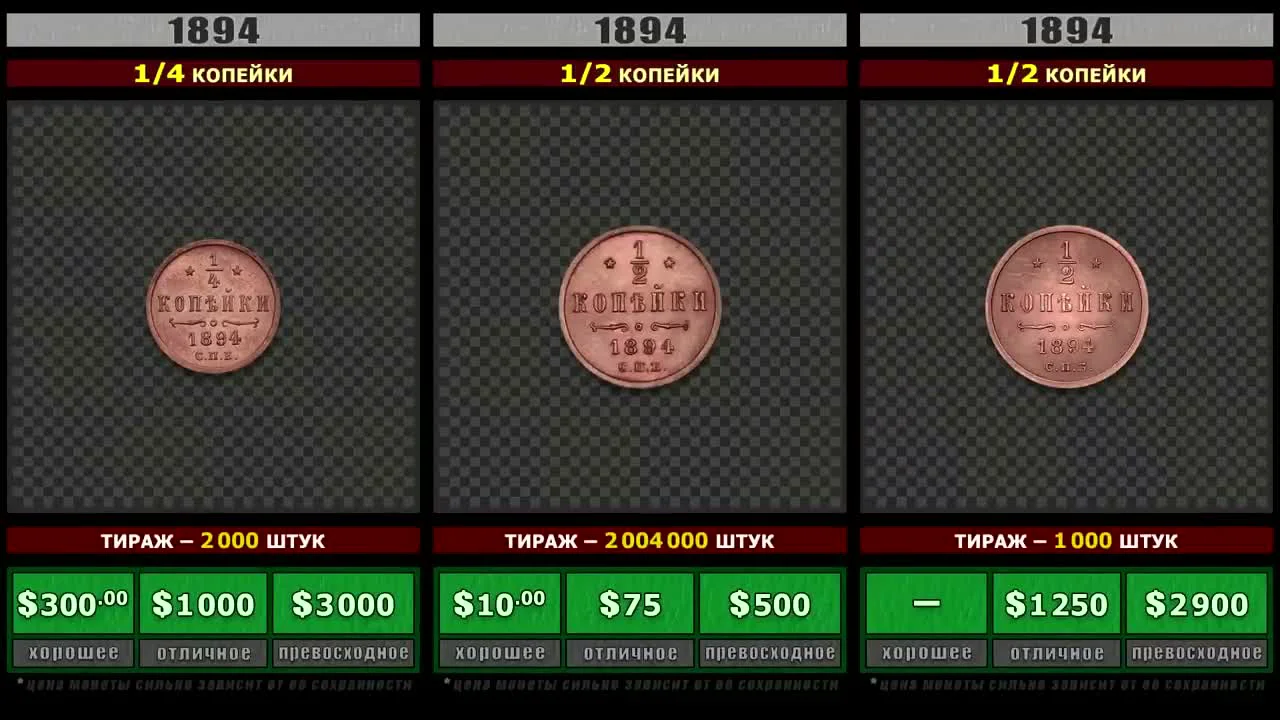
| 1/4 Kopek | 1894 | 2,000 | $300 | $1000 | $3000 |
| 1/2 Kopek (Nicholas II) | 1894 | 1,000 | - | $1250 | $2900 |
| 1 Kopek | 1894 | 15,490,000 | $1.80 | $20 | $250 |
| 1/4 Kopek | 1895 | 60,000 | $50 | $200 | $800 |
| 1/2 Kopek | 1896 | 23,800,000 | $1.25 | $12 | $110 |
| 3 Kopeks | 1898 | 6,783,952 | $1.75 | $15 | $165 |
The beginning of Nicholas II's reign was marked by the issuance of both mass-produced and extremely rare copper coins. Some of them, issued with minimal mintage, are now a true collector's dream and reach high values even in average condition.
For example, the 1894 polushka (1/4 kopek) was minted in a quantity of only 2,000 pieces, making it very valuable. At the same time, coins of larger denominations from the same year were issued in the millions and have a more affordable price.
Turn of the Century (1899–1904): Stability and Mintage
| Coin | Year | Mintage | Price (Good) | Price (Excellent) | Price (Superb) |
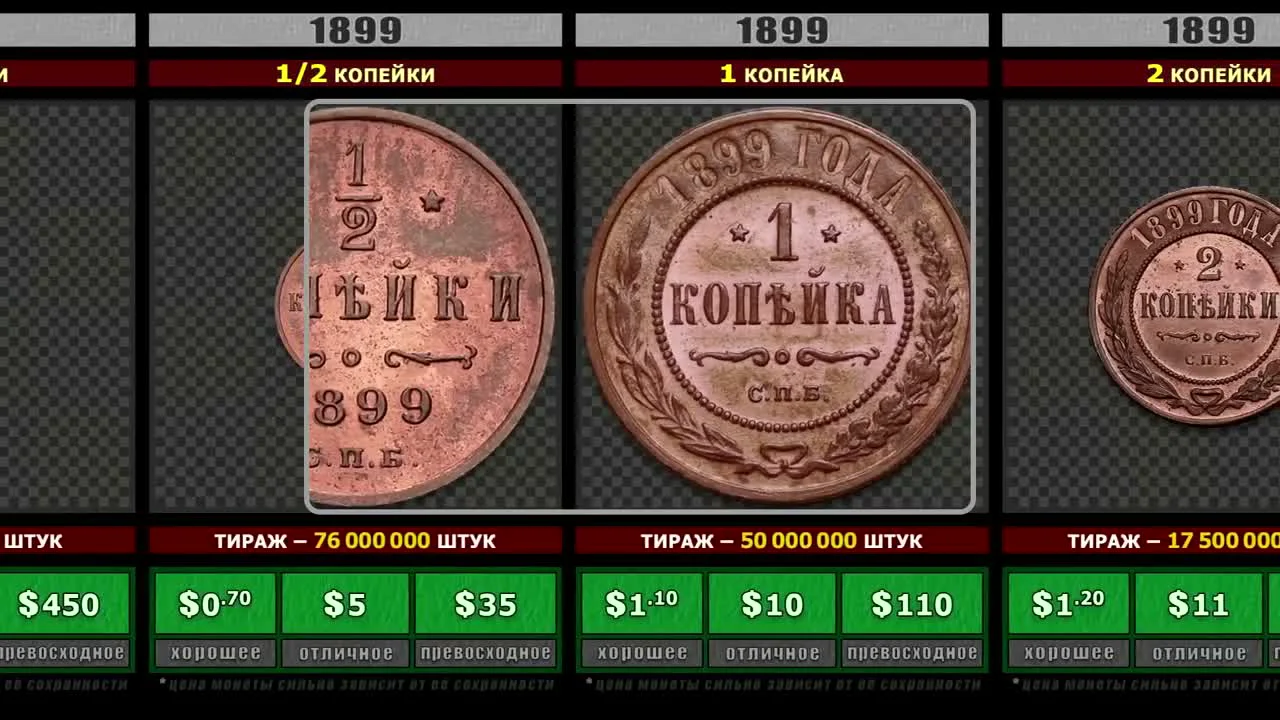
| 1/4 Kopek | 1899 | 8,000,000 | $7.50 | $50 | $450 |
| 3 Kopeks | 1900 | 16,666,667 | $1.25 | $12 | $140 |
| 2 Kopeks | 1901 | 20,000,000 | $1.45 | $15 | $200 |
| 1 Kopek | 1902 | 20,000,000 | $8.25 | $65 | $670 |
| 3 Kopeks | 1904 | 6,933,634 | $2.75 | $25 | $265 |
From 1899 to 1904, the minting of copper coins continued in large quantities, making most of them relatively affordable for collectors. However, even in these years, there are specimens whose value increases significantly in excellent and superb condition.
The 1899 polushka stands out, which, with a mintage of 8 million, is valued at $7.50 even in good condition. Coins of larger denominations, such as the 1900 3 kopeks, can also be interesting for collections, especially in high-grade condition.
Period of Change (1905–1910): Rare and Common Issues
| Coin | Year | Mintage | Price (Good) | Price (Excellent) | Price (Superb) |
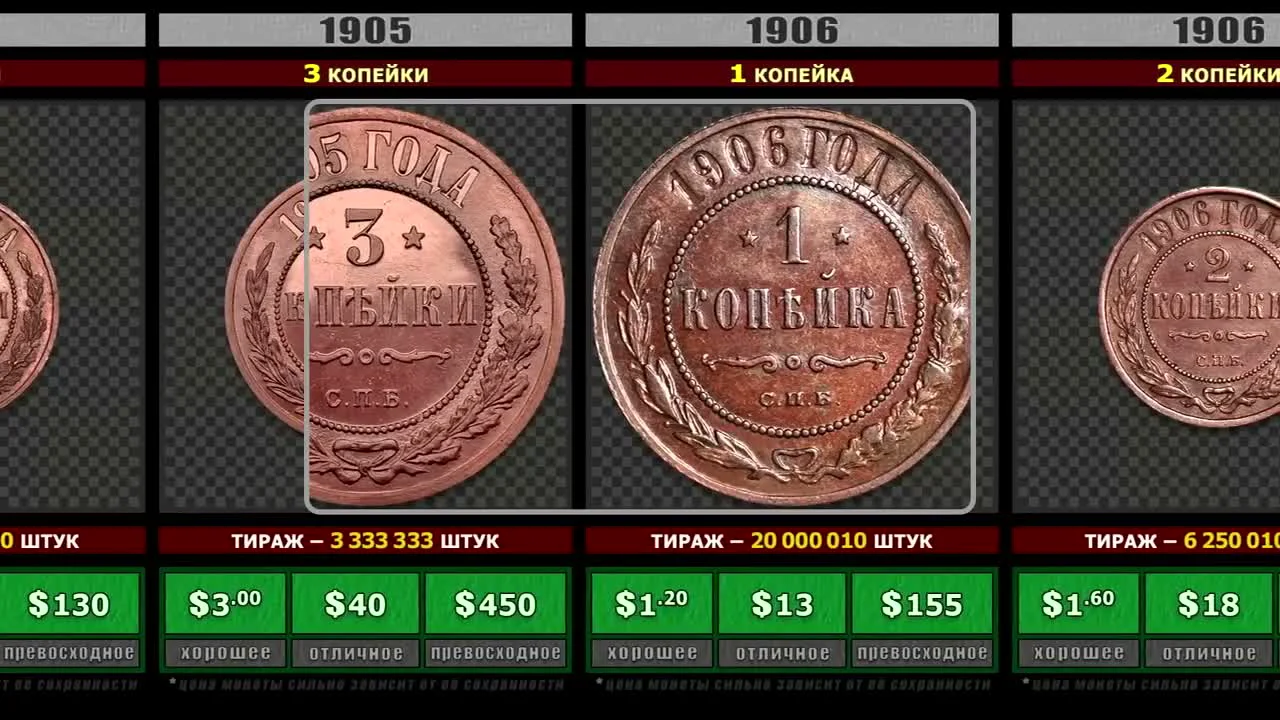
| 3 Kopeks | 1905 | 3,333,333 | $3.00 | $40 | $450 |
| 1 Kopek | 1907 | 20,000,009 | $2.20 | $25 | $270 |
| 1/2 Kopek | 1908 | 8,000,000 | $2.25 | $20 | $150 |
| 1/4 Kopek | 1909 | 2,000,000 | $5.50 | $30 | $250 |
| 2 Kopeks | 1910 | 12,000,009 | $1.40 | $17 | $185 |
These years are characterized by significant fluctuations in coin mintages. Some denominations, like the 1905 3 kopeks, were issued in relatively small quantities, which increases their collector value. At the same time, coins from 1909 and 1910 were minted in the tens of millions, making them more common.
An interesting specimen is the 1909 polushka. With a mintage of 2 million, its value in good condition starts at $5.50. The value of coins heavily depends on the year and condition, which is important to consider when adding to a collection.
Late Period (1911–1916): The Appearance of the 5 Kopek Coin
| Coin | Year | Mintage | Price (Good) | Price (Excellent) | Price (Superb) |
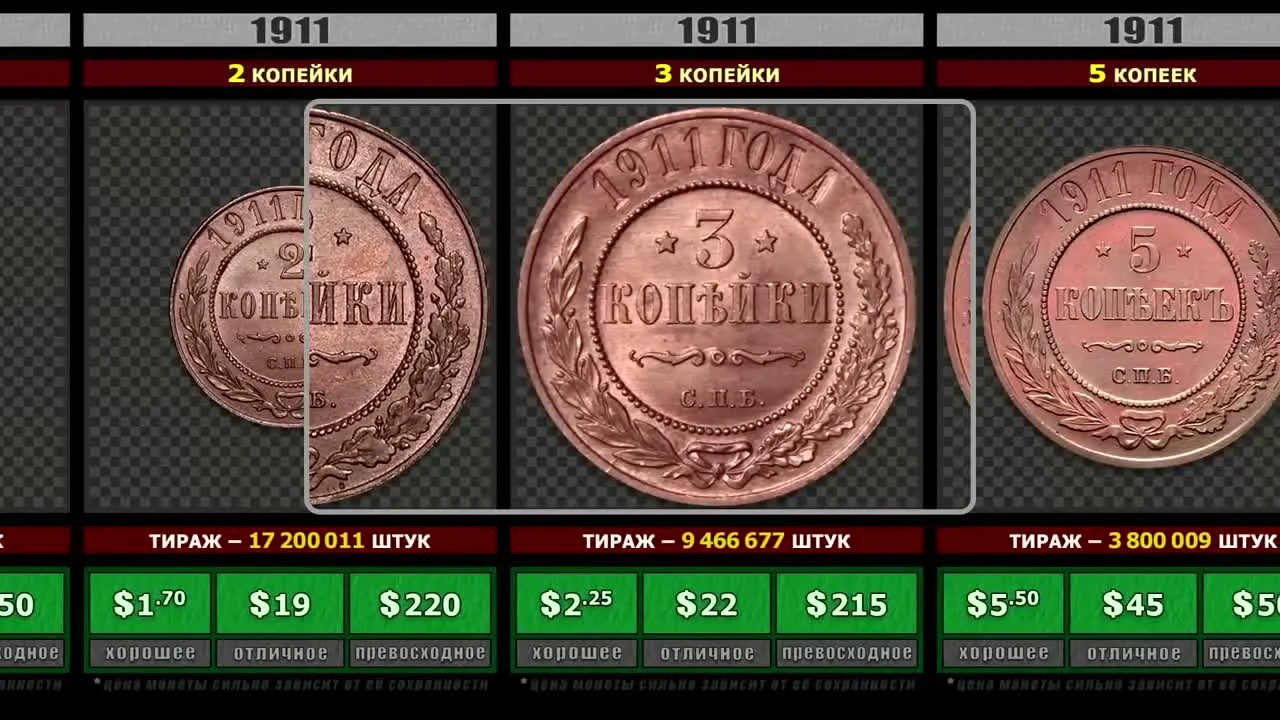
| 5 Kopeks | 1911 | 3,800,009 | $5.50 | $45 | $500 |
| 3 Kopeks | 1912 | 8,533,341 | $2.40 | $25 | $230 |
| 1 Kopek | 1914 | 32,500,014 | $1.55 | $17 | $160 |
| 1/4 Kopek | 1915 | 8,000,000 | $35.00 | $180 | $750 |
| 1/4 Kopek | 1916 | 1,200,000 | $150.00 | $600 | $2500 |
| 5 Kopeks | 1916 | 8,000,000 | $100.00 | $500 | $2500 |
In 1911, a new coin was introduced into circulation — the 5 kopeks. This denomination quickly became popular and was minted in large quantities. Coins from this period, especially those issued during World War I, are of particular interest to numismatists.
Among the rare coins of this time, the 1916 polushka stands out with a mintage of only 1.2 million, its value starting at $150 in good condition. Also noteworthy is the 1916 5 kopeks coin, whose price in superb condition can reach $2500.
The Mystery of the 1917 Coins
The 1917 coins are among the rarest and most expensive in Russian numismatics. Their mintage was extremely small, supposedly up to 5 pieces of each denomination, which sparks debate among collectors about their authenticity and the circumstances of their issue. The value of such coins can reach tens of thousands of dollars.
In the late 1990s, a set of genuine 1917 coins was offered to the State Historical Museum for $73,000. The museum declined the purchase, and the coins ended up in a private collection in Moscow. Due to their high cost and rarity, there is a large number of counterfeits on the market, so extreme caution is required when purchasing such specimens.
- Polushka (1/4 kopek) 1917 — price up to $30,000
- Denga (1/2 kopek) 1917 — price up to $30,000
- 1 kopek 1917 — price up to $30,000
- 2 kopeks 1917 — price up to $30,000
- 3 kopeks 1917 — price up to $30,000
- 5 kopeks 1917 — price up to $30,000