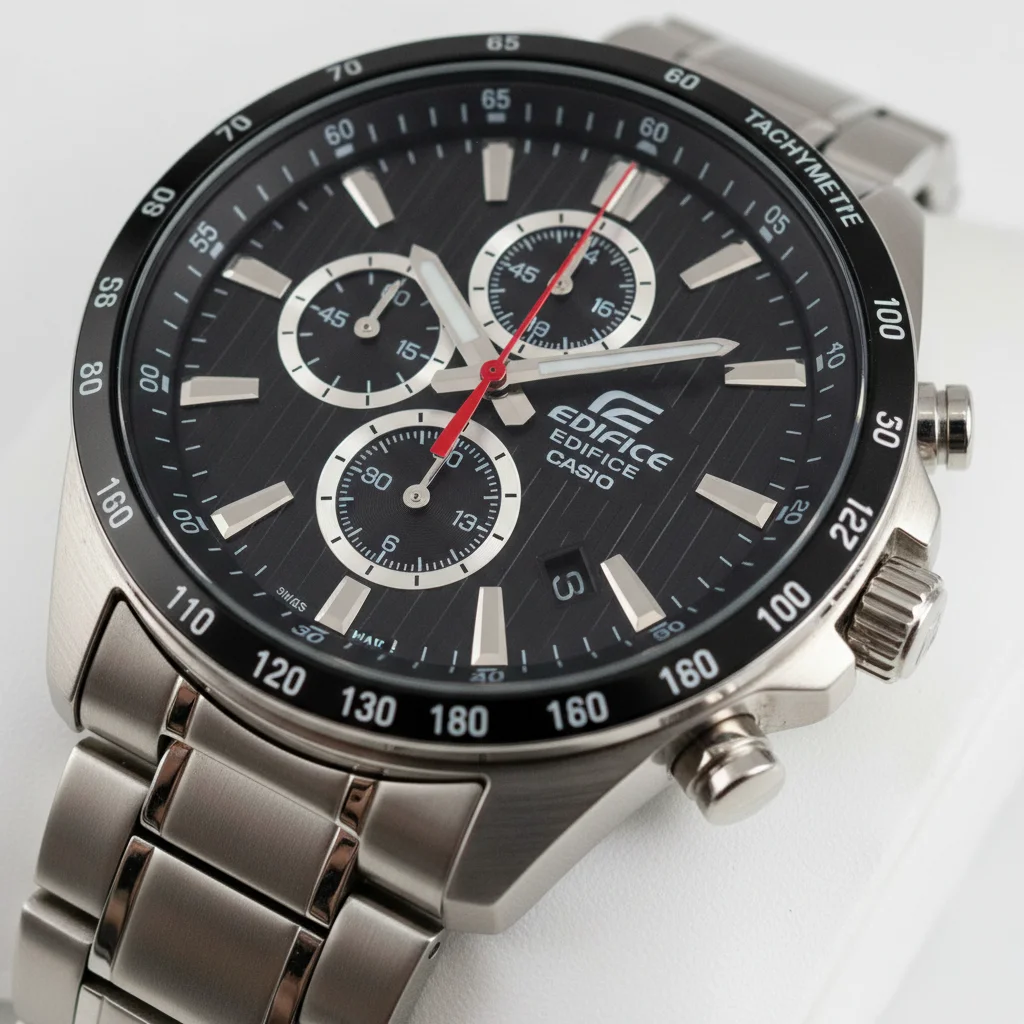
History and Types of Chronographs
| Chronograph Type | Description |
| Classic | The standard and most common type, which functions as a stopwatch. |
| Split-Seconds Chronograph | Equipped with two central seconds hands, allowing the timing of two events simultaneously. One hand can be stopped to record an intermediate time, while the other continues to run. |
| Flyback Chronograph | Allows you to reset the timer and instantly start a new measurement with a single button press, without needing to stop the stopwatch first. |
The chronograph as we know it today appeared in the early 20th century. Initially, this feature gained great popularity in aviation and sports, where precise measurement of short time intervals was required.
There are several main types of chronographs, each with its own features and purpose. From a simple stopwatch to complex mechanisms for professional use, they significantly expand the functionality of wristwatches.
These complications make chronographs not only a stylish but also a very practical accessory for various tasks.
How a Chronograph Works
In essence, a chronograph is an additional stopwatch built into the watch movement. A watch with this function is easily identified by two extra buttons on the side of the case and several small subdials on the main dial.
The central seconds hand on such watches is usually stationary, positioned at '12 o'clock'. It is specifically responsible for the stopwatch function. The running seconds are displayed on one of the small subdials.
- Top button: Starts and stops the timer.
- Bottom button: Resets the readings to zero after stopping.
This principle is the same for both mechanical and quartz models. However, quartz chronographs can typically measure time with greater accuracy, for example, down to 1/100th of a second, which is why their hands move much faster.
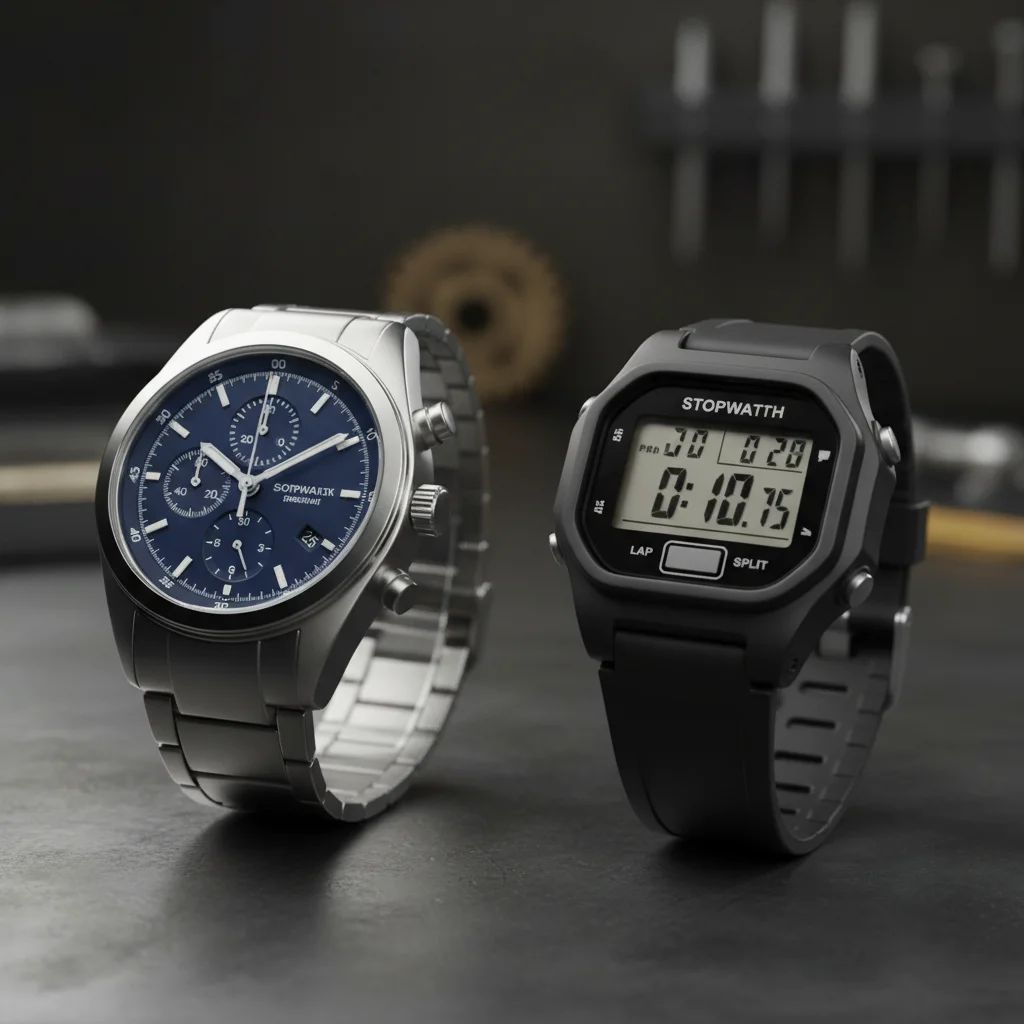
Comparison and Accuracy of Movements
To demonstrate the operation and compare the accuracy, three types of watches can be used: a mechanical chronograph (e.g., 'Okean' 3133), a quartz one (Casio Edifice), and an electronic one (Skmei) as a reference.
When a mechanical chronograph is started, the central seconds hand begins to move. After it completes a full rotation, the hand on the subdial moves one increment, marking the elapsed minute.
During an accuracy test, the Casio quartz chronograph and the electronic watch were started and stopped simultaneously. The electronic watch showed a result of 18.53 seconds, while the quartz chronograph recorded 18.55 seconds. This minimal margin of error confirms the high accuracy of quartz movements.
Despite their high accuracy, chronographs are most often used in daily life for simple tasks, such as timing food preparation.
Calibrating a Quartz Chronograph
Sometimes, especially after changing the battery in a quartz watch, the chronograph hands may not return to the zero position when reset. While this problem in mechanical watches can only be fixed by a watchmaker, in quartz watches, the calibration can be done yourself.
The calibration process is quite simple and is performed in a few steps.
- Pull the crown out to the final position.
- Press and hold the top button. The central seconds hand will start to rotate.
- Use short or long presses of the top button to position the hand exactly at the '12 o'clock' (zero) mark.
- Push the crown back to its original position.
After this procedure, the chronograph will be calibrated, and its hands will return to the correct starting position upon reset.
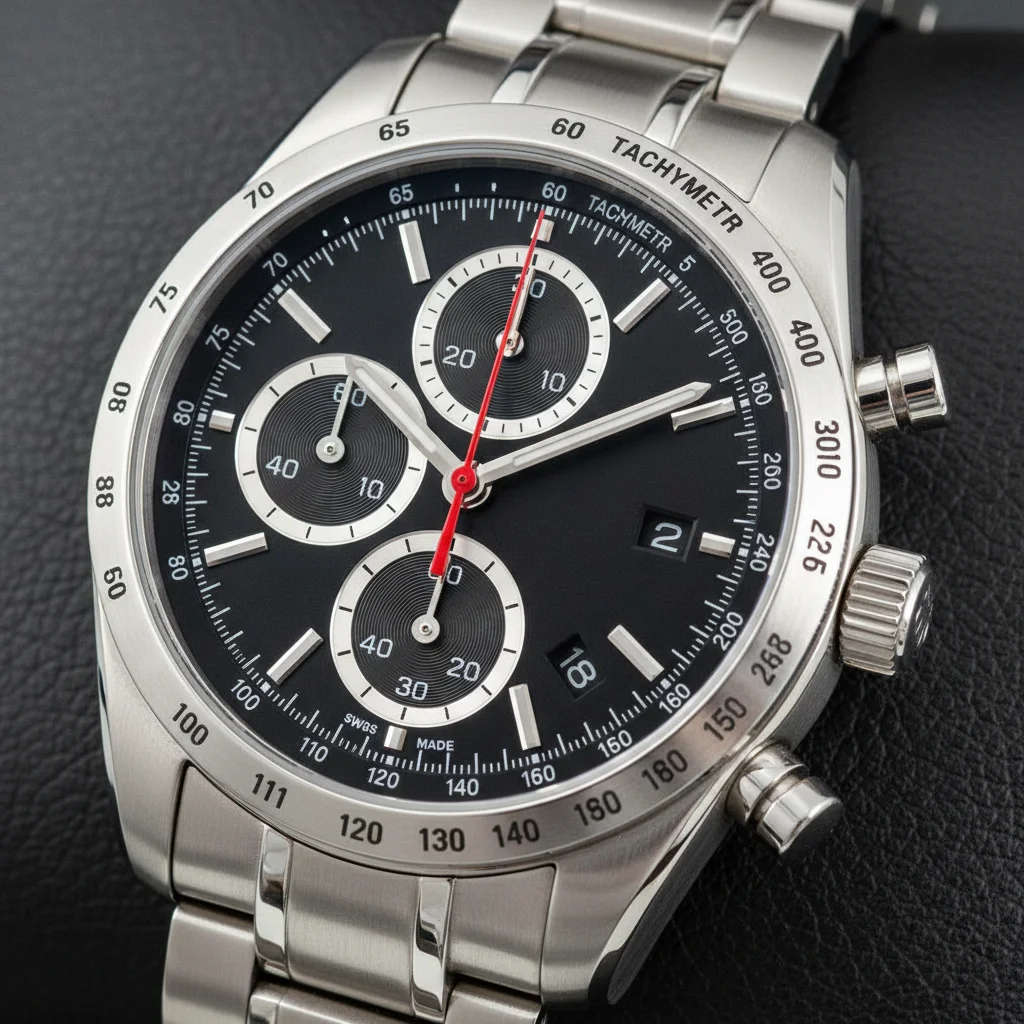
Review of the Casio Edifice EF-506 Watch
As an example of a quartz chronograph, let's look at the Casio Edifice EF-506 model. This watch is a comfortable and functional accessory for everyday wear.
The case and bracelet are made entirely of stainless steel. The bracelet is solid link with a butterfly clasp, ensuring reliability and comfort. The watch weighs about 150 grams.
Key features of the model:
- Case diameter: 40 mm
- Thickness: 11.5 mm
- Water resistance: 10 BAR (up to 100 meters)
- Functions: Chronograph with 1/100-second accuracy, date window, small subdial with a 24-hour time format.
The 24-hour indicator makes it easy to determine whether it is AM or PM. The water resistance allows for swimming in a pool or river, but the watch is not intended for scuba diving. Thanks to its moderate size, the model fits comfortably even on a small wrist.