
Historical Context: The Monetary Reform of Anna Ioannovna
The denga coin from the period 1730-1756 is one of the most common finds in fields and forests. The story of its mass appearance is linked to the monetary reform of Empress Anna Ioannovna, who decided to lower the coinage standard.
The overstriking of old coins was promptly initiated. This process affected various coins from previous reigns, which served as planchets for the new dengas and polushkas.
- Lightweight kopeks of Peter I were overstruck into dengas.
- Rare framed kopeks of Catherine I from 1726 were also turned into dengas.
- Lightweight cross kopeks of Peter II became polushkas.
1730-1734: The Golden Years for Collectors
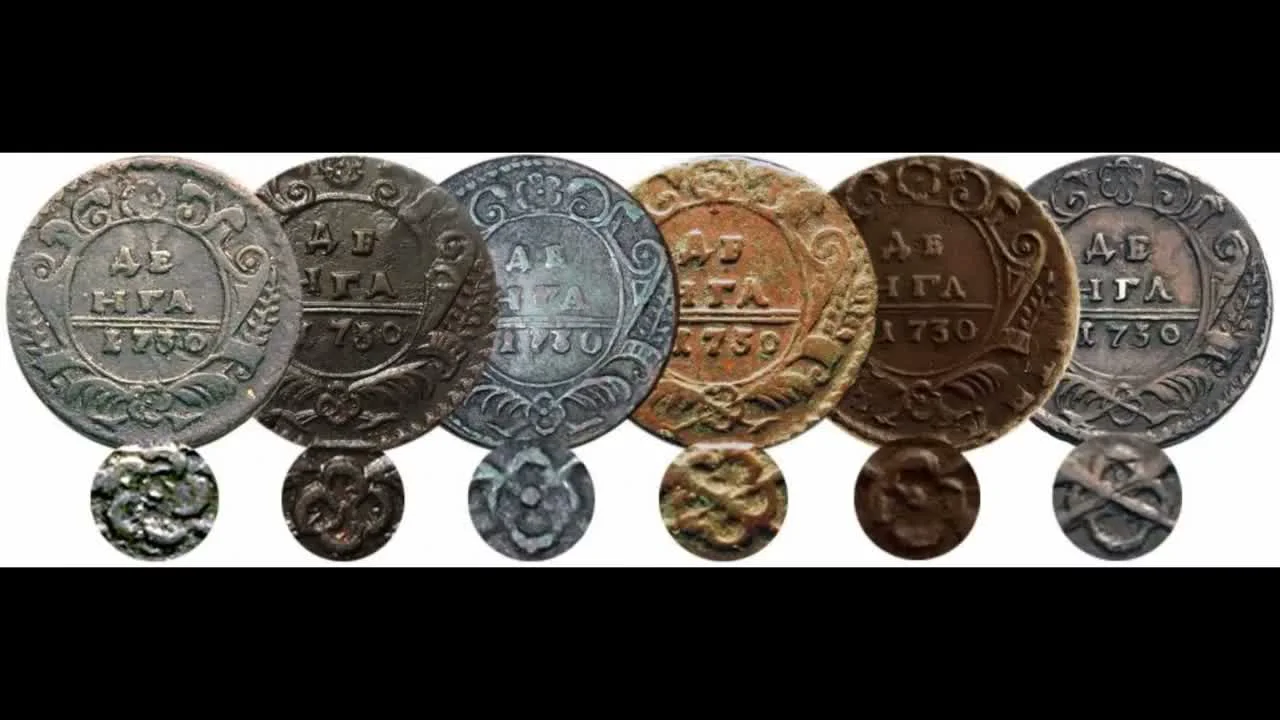
The period from 1730 to 1734 is considered the most interesting and rich in varieties for denga coins. In 1730 alone, there are about 50 known standard varieties, and possibly more. This year marked the beginning of production when the technology for overstriking and die making was being actively developed.
It was during this period that new masters honed their skills, while experienced ones created true works of art. The collection and description of all variants continue to this day, and numismatists occasionally discover previously unknown types.
The year 1730 is of particular interest, as the pattern and design of the coins from this period are exceptionally rich in variations. This provides collectors with a broad field for research and the search for rare specimens.
Key Design Elements and Their Variations
| Term | Description |
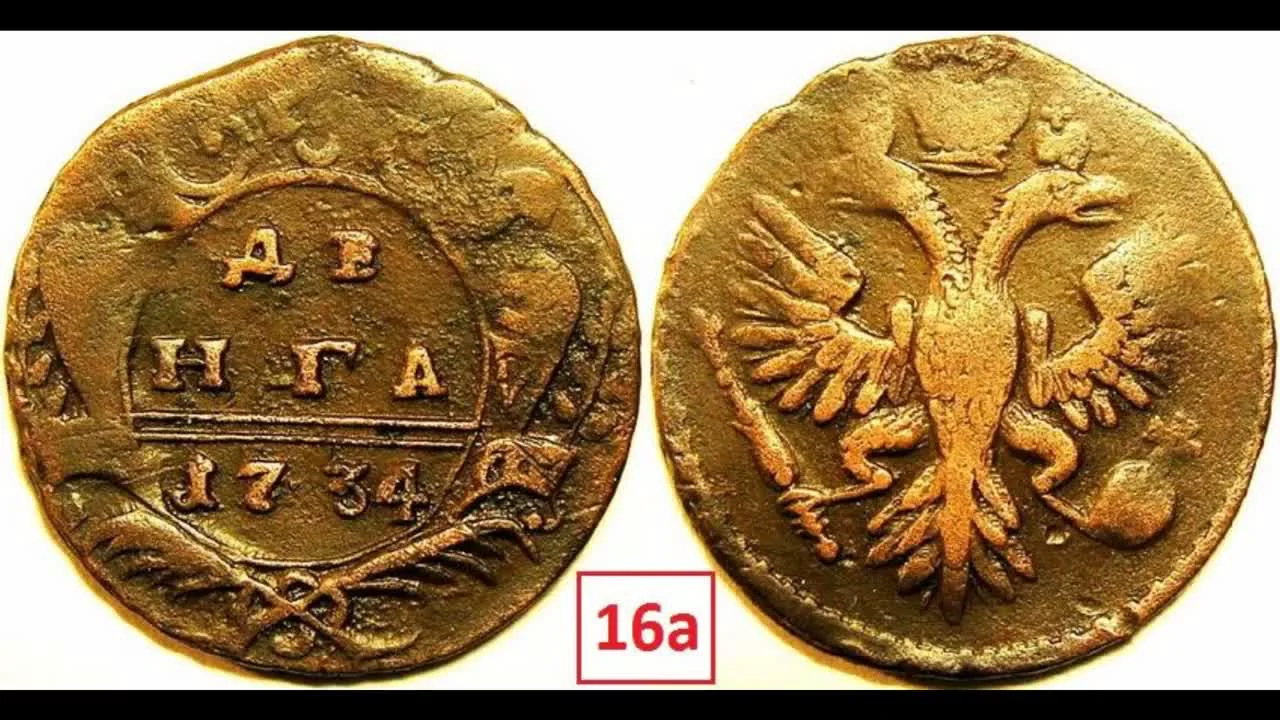
| Obverse | The front side of the coin, usually featuring the coat of arms (eagle). |
| Reverse | The back side of the coin, typically indicating the denomination and year. |
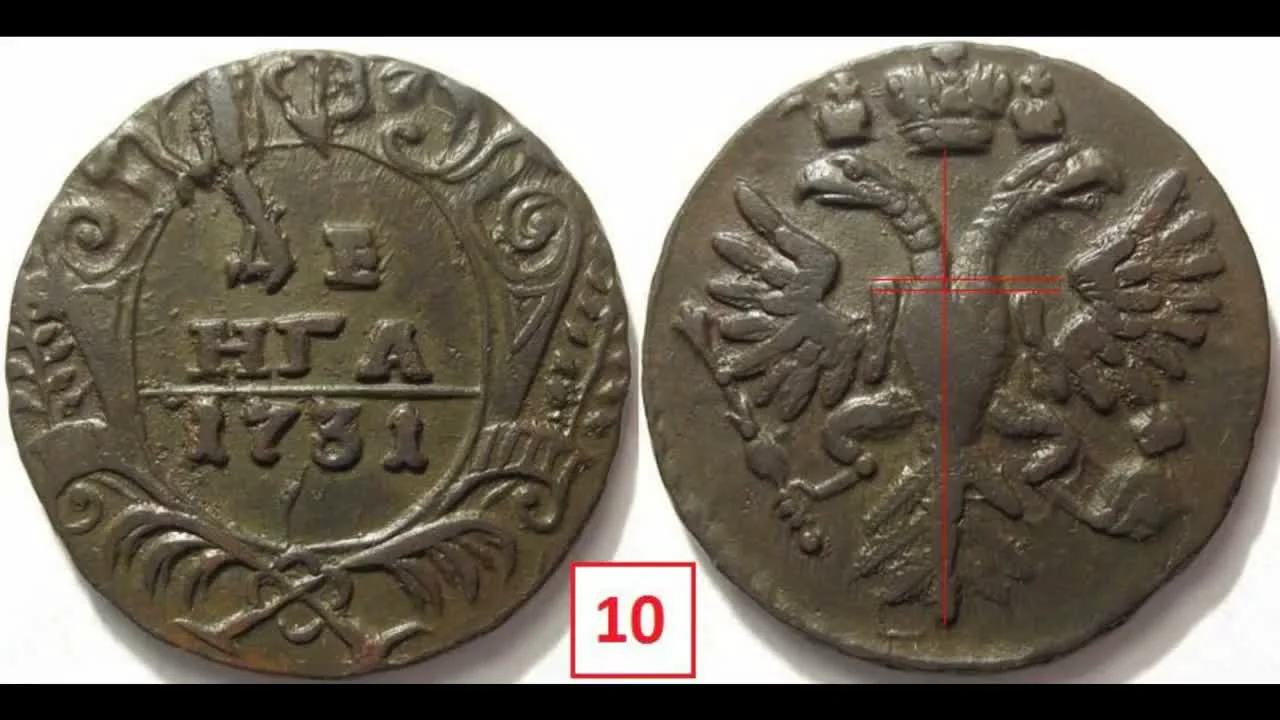
The main characteristic of denga coins from this period is their incredible diversity. Differences appear in the smallest details on both the obverse and the reverse. Understanding these elements is the key to determining the rarity and value of a coin.
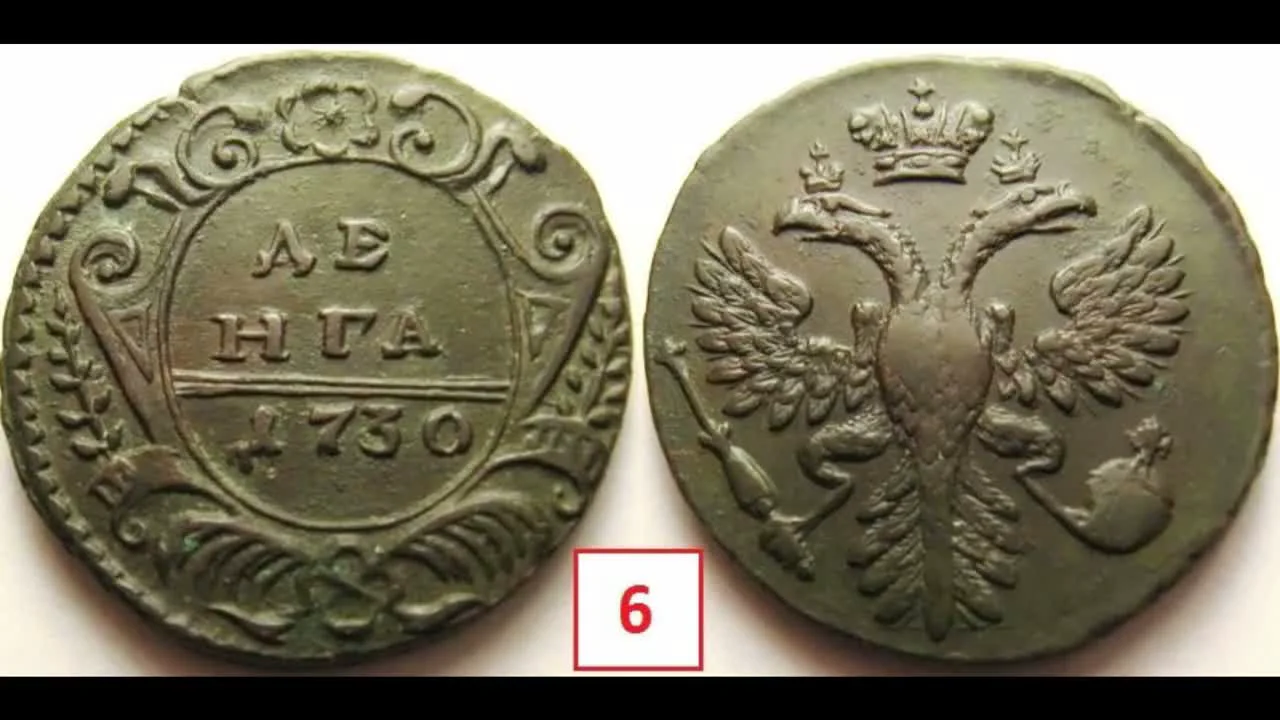
- Eagle: number of feathers, presence or absence of tongues, shape (simple or ornate).
- Crowns: size, shape (open or closed), presence and shape of the crosses above them.
- Orb: shape of the cross (simple or patterned), size.
- Rosettes and bows.
- Laurel and palm branches.
- Number of leaves in the branches.
- Number of dividing lines above the year.
Prototypes and Protection Against Counterfeiting
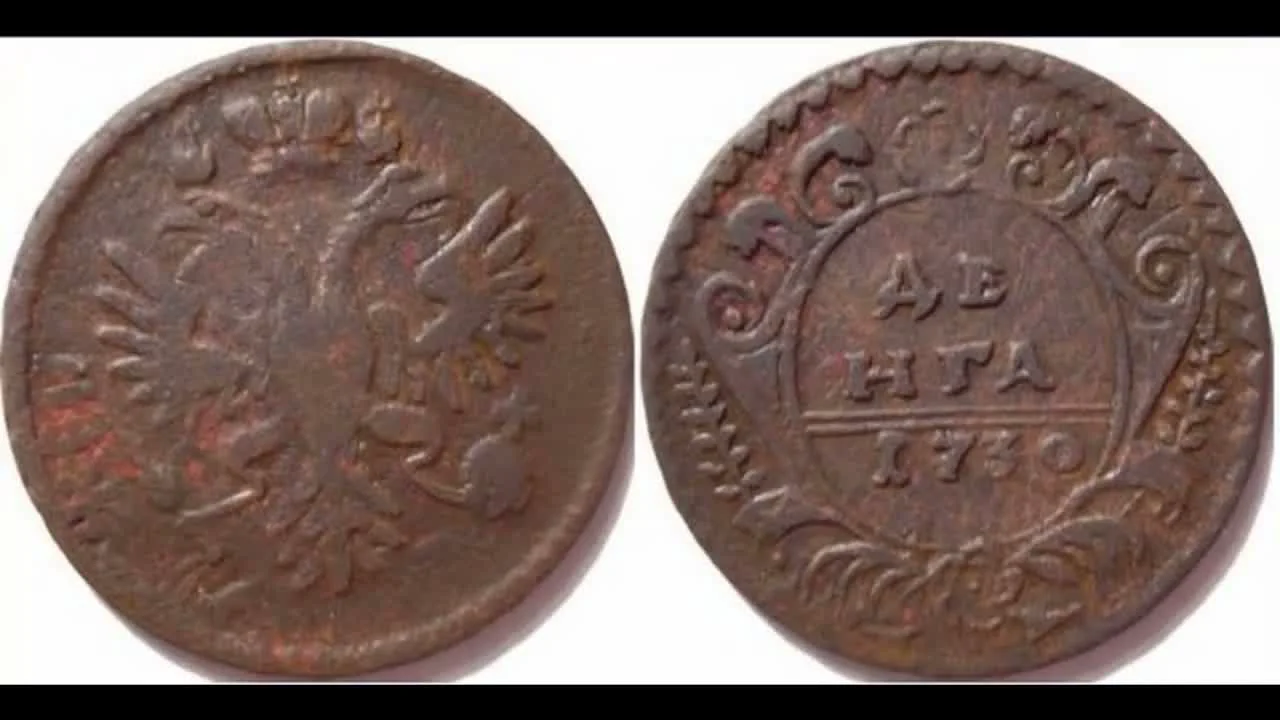
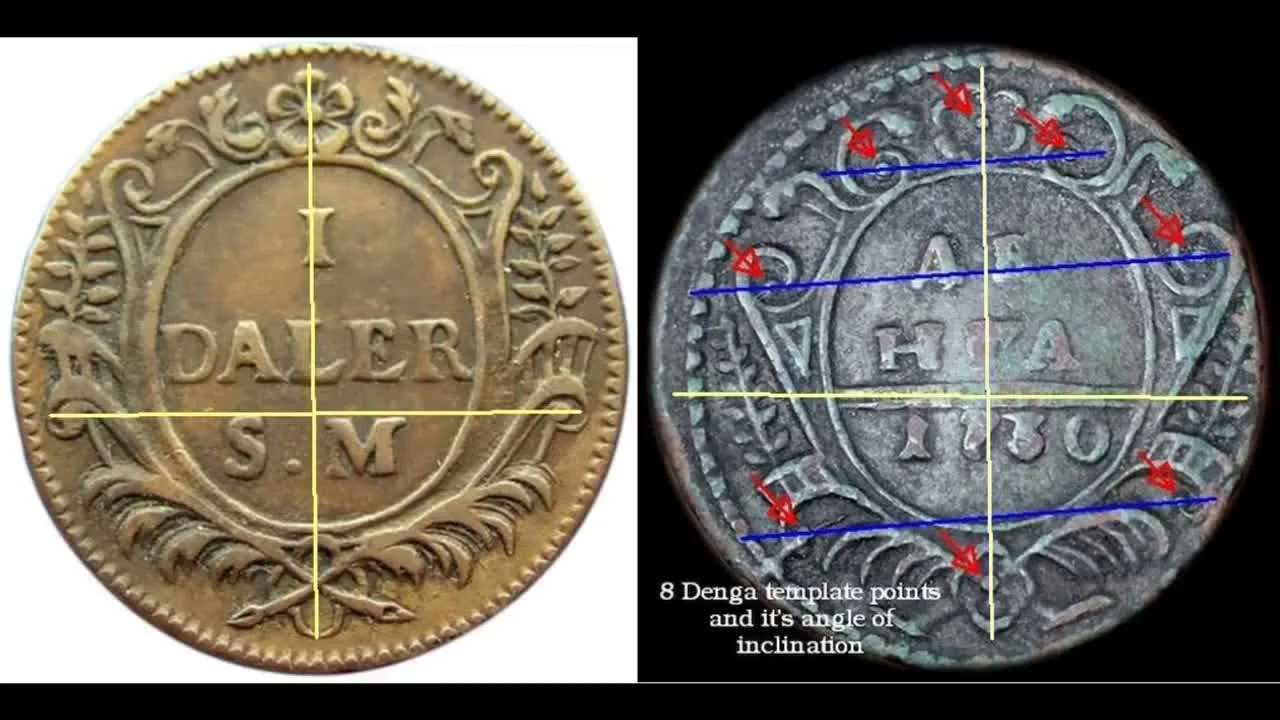
The design of the denga coins was not entirely original. The masters who worked on creating the dies drew inspiration from existing coins. The prototype for the reverse side was a Swedish 1 daler coin from 1718.
For the eagle on the obverse, ornate eagles from silver coins of previous years were used as a basis. However, changes were made to the design, such as adding new tail shapes. The design was deliberately complicated to protect the coins from counterfeiters. This is why 1730 saw the emergence of some of the most beautiful and detailed "ornate" eagles in the entire history of copper coinage.
The Template System for Coin Classification
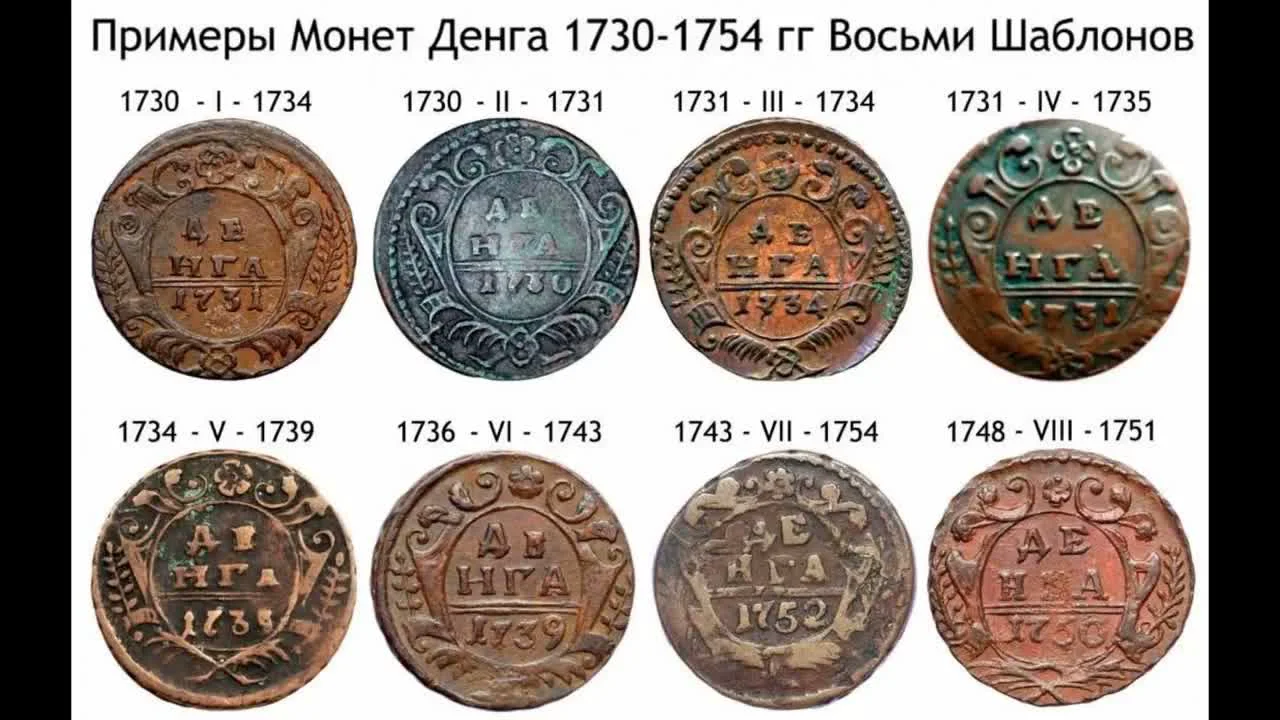
To systematize the vast number of varieties, numismatist G.S. Evdokimov developed a template system. A template is a set of features that unites large groups of coins. All coins were minted with different dies, but they can be grouped by a common template.
Within one group, the design may differ in minor details, but the placement of key "template points" remains unchanged. This placement determines the angle of inclination and distortion of the design relative to the vertical axis. Such distortion was intentionally introduced to complicate the work of counterfeiters.
Evdokimov identified all the templates for denga and polushka coins issued from 1730 to 1754. For a detailed study, it is recommended to consult his work "Dengas and Polushkas of the 1730-1754 Issue."
The Search for the Earliest Denga: Template #1 vs. Template #2
The first two templates are of particular interest to researchers, as both are found on 1730 coins. G.S. Evdokimov believed that Template #1 was the earlier one. However, later observations suggest the opposite: Template #2 was most likely the earlier one.
This conclusion is based on statistical analysis. Coins with Template #2 are found in large numbers in 1730 (more than 40 out of ~50 variants) and rarely in 1731. At the same time, coins with Template #1 are rare for 1730 (about 4 variants) and are much more common in 1731. This indicates that Template #2 was the primary one in the first year of minting, while Template #1 became dominant later.
Visually, the templates can be distinguished by the distance between the second and third scrolls to the right of the rosette. In Template #1, this distance is minimal, while in Template #2, it is large.
Template Points: A Flaw or a Sign of Early Minting?
In the search for the very first 1730 denga coin, special attention is paid to specimens with eight clearly defined template points on the reverse. One of these points, located on the bow below the year, is particularly rare.
There is a hypothesis that the presence of this point is not a design element but a production flaw. At the beginning of the new coin issue, when the technology was still being refined, masters might have accidentally created this point due to an imperfect tool or an incorrectly calculated strike force.
If this point is not a harmonious part of the design, its presence may indicate the earliest dies. Such coins are of particular interest to collectors as potentially the first specimens of the new denga type.