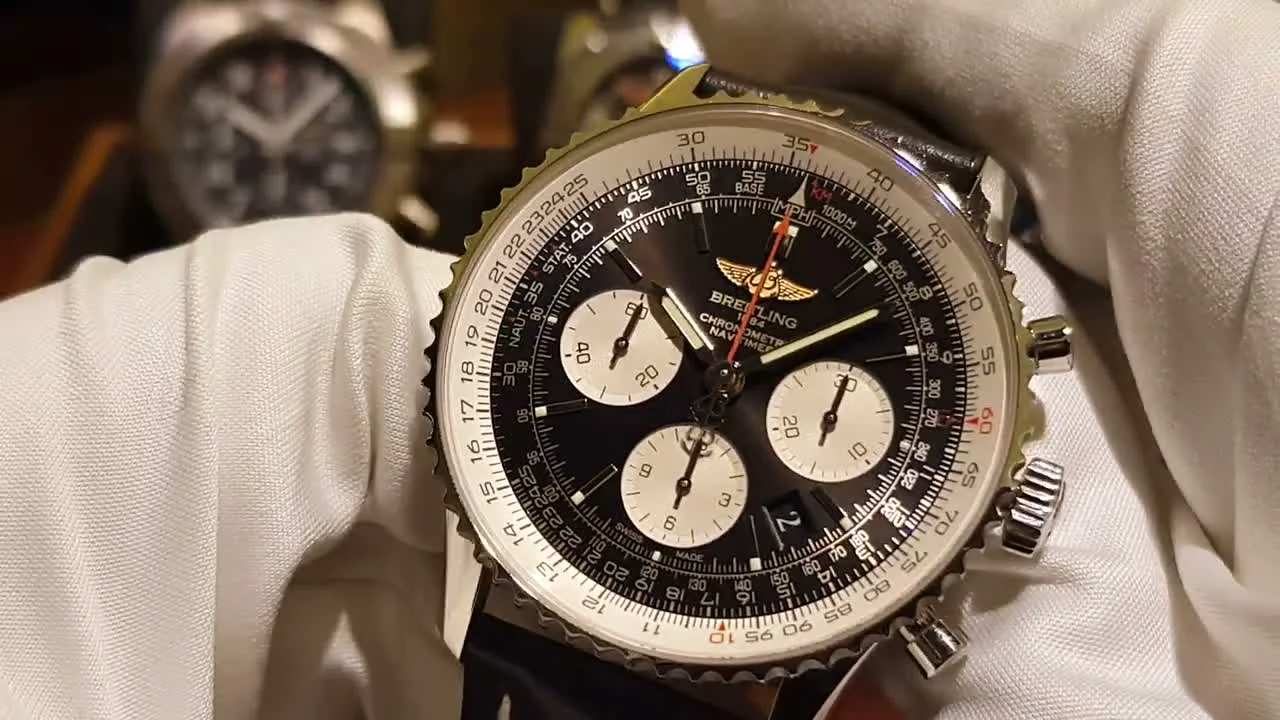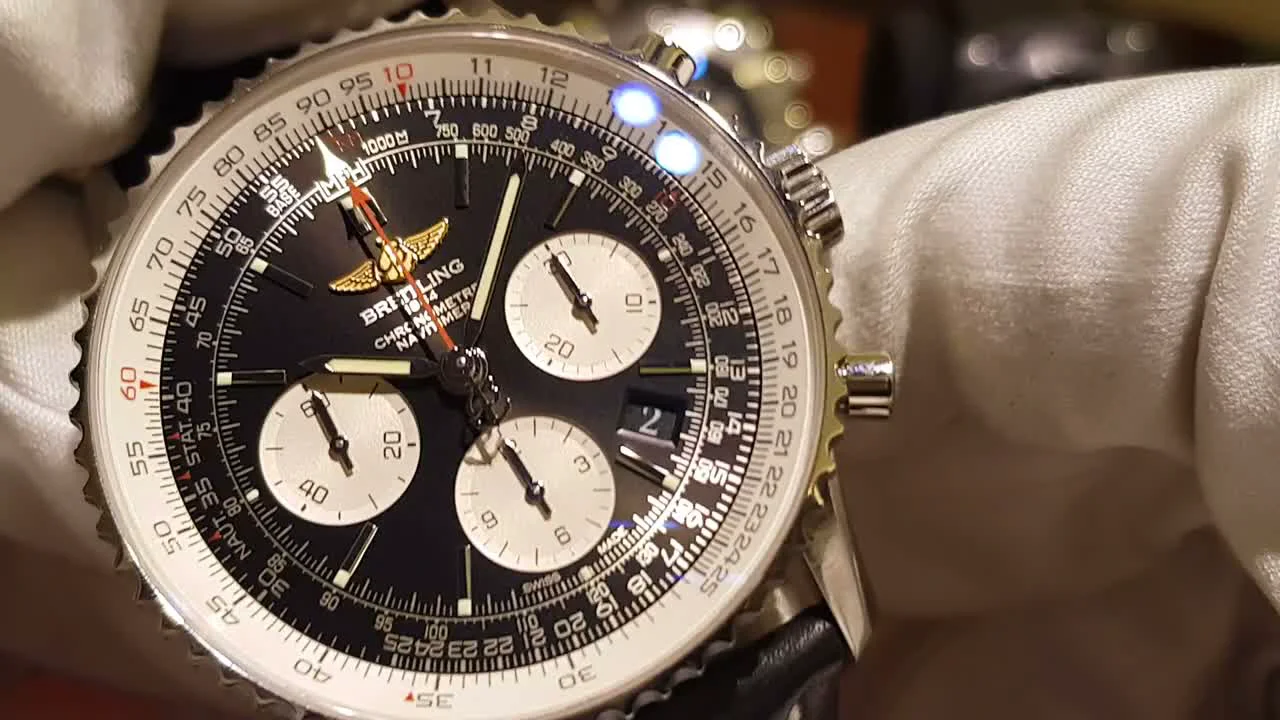

What is a Slide Rule on a Watch?
| Component | Description |
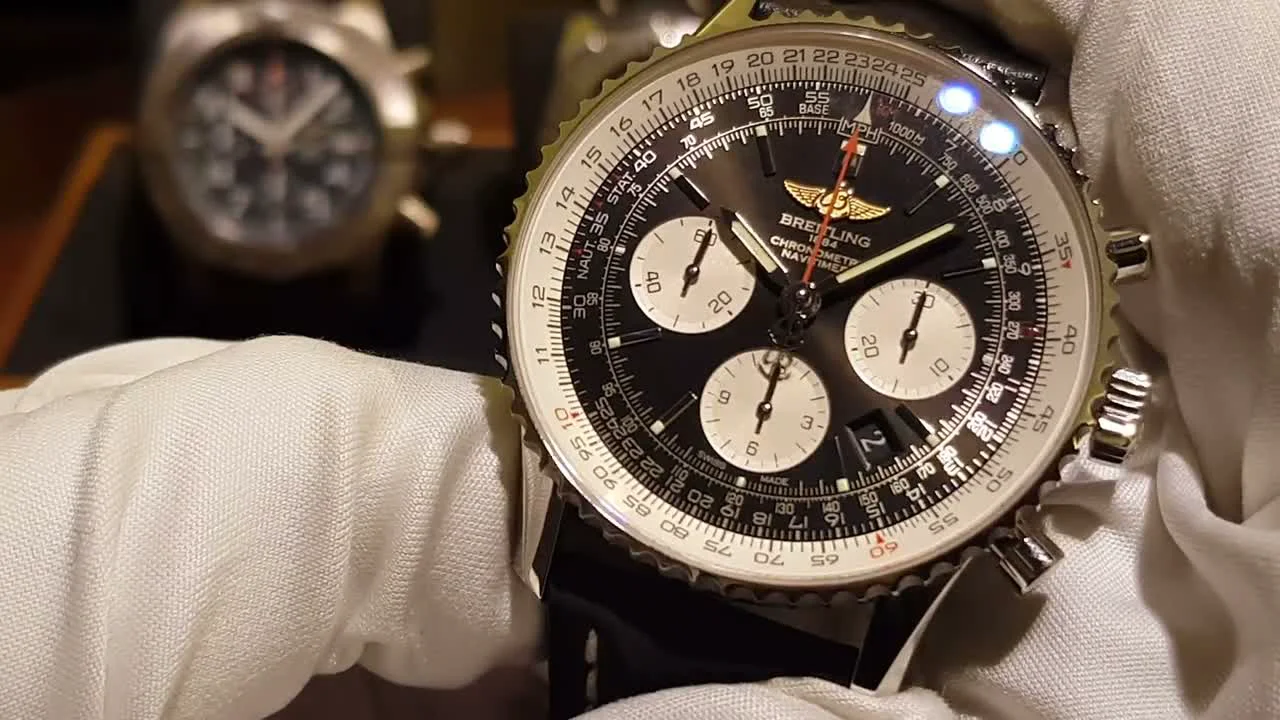
| Outer Scale | Located on the rotating bezel (rim) of the watch. Usually white in color. |
| Inner Scale | Located on the watch dial; it is stationary. |
| Bezel | The rotating rim around the dial that allows you to align values on the outer and inner scales. |
The slide rule built into a watch is a kind of analog calculator. It allows you to perform a variety of mathematical calculations, from simple multiplication and division to more complex operations like finding the square root.
This tool consists of two main scales that interact with each other when the bezel is rotated. Understanding how they work is the key to using its full functionality.
All calculations are performed by aligning specific values on these two scales. Using the Breitling Navitimer watch as an example, we can see how this works in practice.
Multiplication Using a Slide Rule
The simplest operation you can perform with a slide rule is multiplication. The process is intuitive and requires only a few steps.
Let's consider the example of multiplying 14 by 15. To do this, you need to follow these steps:
- Find the number 14 on the outer scale (the white bezel).
- Align this number with the special '10' mark (usually red) on the inner, stationary scale.
- Now, without moving the bezel, find the second multiplier—the number 15—on the inner scale.
- The result of the multiplication will be on the outer scale, directly opposite the number 15. In this case, it's the '21' mark, which means 210.
Thus, 14 multiplied by 15 equals 210. This method allows you to quickly get results without using electronic devices.

Performing Division
Division is performed using the reverse principle of multiplication. It is also a simple operation that is easy to master.
For example, let's divide 240 by 12. The sequence of actions is as follows:
- Find the dividend (240) on the outer scale. It will be marked as '24'.
- Align this number with the divisor (12) on the inner scale.
- The result of the division will be shown on the outer scale opposite the '10' mark on the inner scale.
In this case, the number '20' will be opposite the '10' mark. Therefore, 240 divided by 12 is 20.
Squaring a Number
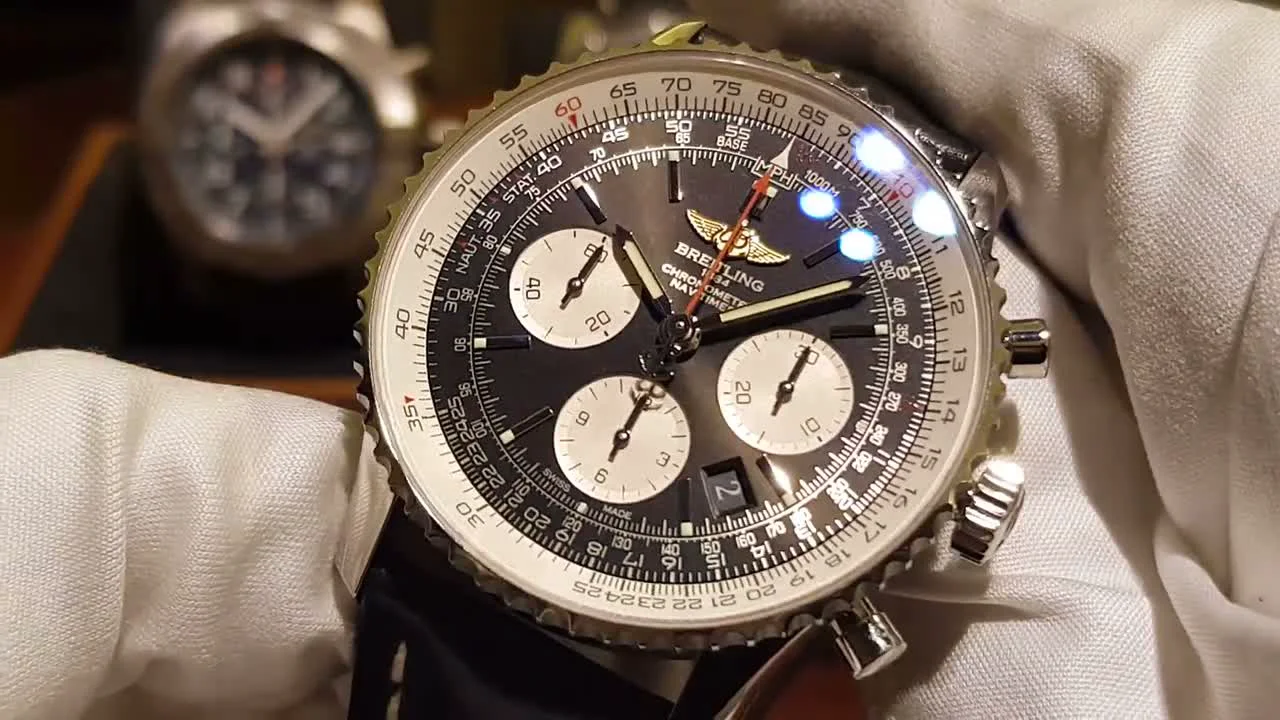
With a slide rule, you can also square numbers. This process is very similar to multiplying a number by itself.
Suppose you need to calculate 15 squared. The steps are as follows:
- On the outer scale, find the number you want to square — 15.
- Align it with the '10' mark on the inner scale.
- Then, find the number 15 on the inner scale.
- The result will be visible on the outer scale opposite this number. In this case, it is 22.5, which should be interpreted as 225.
Thus, 15 squared is 225. This method allows for quick calculations for any two-digit numbers.
Finding the Square Root
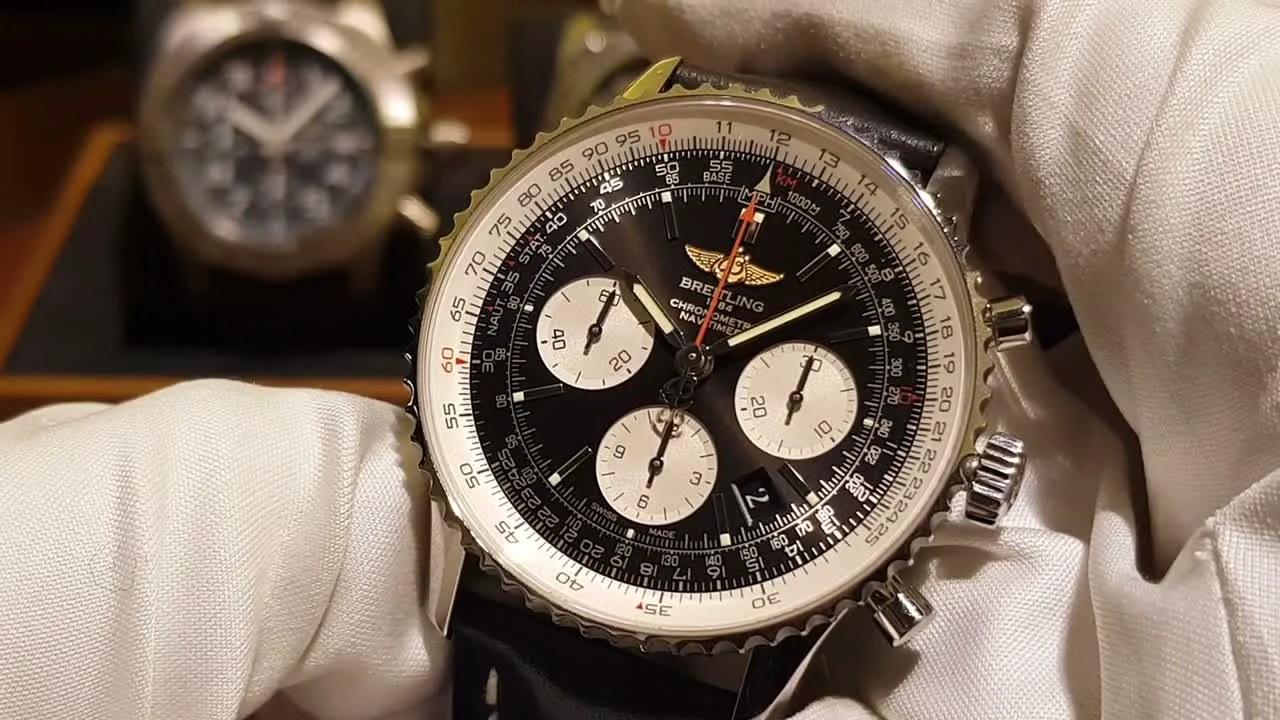
Finding the square root is a more complex operation that requires attention to detail. Here, you need to find a number that, when aligned on the two scales, gives the desired result.
Let's take the example of finding the square root of 196. The task is to find a number that is simultaneously on the inner scale opposite 196 (marked as 19.6) on the outer scale, and on the outer scale opposite the '10' mark on the inner scale.
The process comes down to trial and error: by rotating the bezel, you need to find the position where the values align. In this case, by rotating the bezel, you can find that the number 14 is the solution: it is on the inner scale opposite 196 on the outer scale, and simultaneously, 14 on the outer scale is opposite the '10' mark on the inner scale. Thus, the square root of 196 is 14.
Practical Application: Calculating Fuel Consumption
The slide rule can be used for practical tasks, such as calculating hourly fuel consumption. This is especially useful in aviation.
Suppose 150 liters of fuel were consumed in 25 minutes. To find the hourly consumption, you need to do the following:
- Find the consumption value (150 liters, on the scale as '15') on the outer scale.
- Align it with the consumption time (25 minutes) on the inner scale.
- Find the special triangle-shaped mark on the inner scale, which symbolizes 60 minutes (one hour).
- Opposite this mark on the outer scale, the hourly fuel consumption will be indicated. In this example, it is 352, which means 352 liters per hour.

Practical Application: Calculating Distance
Another practical example is calculating the distance traveled based on speed and time. This can be useful for pilots or drivers.
Suppose a helicopter is flying at a speed of 240 km/h. What distance will it cover in 46 minutes?
- Align the speed mark (240, on the scale as '24') on the outer scale with the special hour marker (the triangle at 60) on the inner scale.
- Now, find the required time in minutes—46—on the inner scale.
- Opposite this mark on the outer scale, the distance traveled will be shown. In this case, it is 184, which means 184 kilometers.
This function allows you to quickly perform navigation calculations with only a watch on hand, even if other instruments have failed.