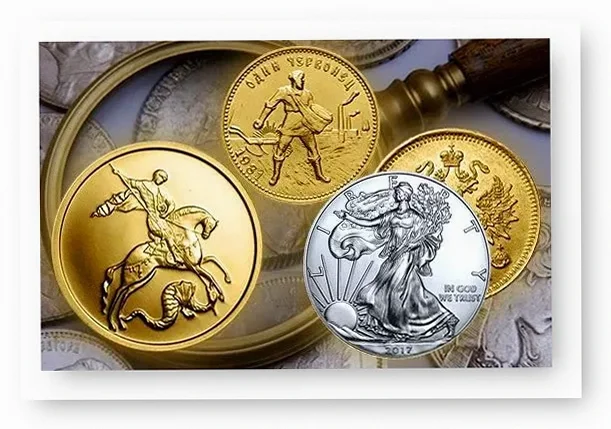

The Birth of the Market: Precious Metal Coins in the USSR and Russia
The history of minting <b>precious metal coins</b> in the territory of the former USSR and modern Russia dates back to the 1970s. The first issues of the Soviet era were intended for the 'capitalist market' and sold for foreign currency to citizens of other countries, primarily those not part of the Warsaw Pact.
The inhabitants of the USSR themselves initially had no opportunity to acquire such coins. It was only in the nineties that our compatriots were able to purchase <b>collectible coins</b> and <b>investment coins</b> made of precious metals, when a legal market for sales in rubles began to form in the country. The circulation of these valuable banknotes became regulated by the state, and corresponding legislation appeared, which continues to change to this day, as does the tax base.
From 1975 to the present day, <b>precious metal coins</b> are made from gold, platinum, silver, and palladium. Their official acquisition is possible through Sberbank, other Russian and international banks. There are also various numismatic clubs and auctions where such banknotes can be offered as lots. Trading organizations, bank employees, private collectors, and numerous experts deal with issues of circulation and valuation.
Coin Anatomy: From Obverse to Edge
On the front side, or obverse, of the coin, state symbols, a city symbol, bank logo, denomination, and minting date are usually depicted. Additional information is often also indicated here.
- Coin weight, in grams.
- Mint that produced the mintage (St. Petersburg — SPMD, Moscow — MMD).
- Chemical symbol of the element according to the periodic table (Au, Ag, Pt).
- Metal purity – the percentage ratio of pure precious metal to the total mass of the item.
The reverse side, or tail, can feature a portrait of a famous person, a thematic drawing, or another image that became the theme of the issue. Interestingly, in the history of the USSR, there were cases when the denomination was indicated on the reverse, for example, on the 1923 chervonets and some series from the 19XXs. From 1977-82, Soviet coins had an incused identifier for the pure gold weight and a mint mark. Modern commemorative coins of the Central Bank of the Russian Federation can also have incused lettering on the reverse.
Along the edges of the image is a rim, which rises above the general surface, forming a thin raised ring. The edge of minted coins is called the gurt; it can be smooth or reeded (with notches). Information (text and images) is most often executed in relief, meaning it protrudes above the flat areas of the surface. However, as with the denomination on the reverse, there were exceptions: the Soviet bank issued gold chervonets of 19XX with an incused inscription.
All markings on the surface (letters, numbers, symbols) are called the 'legend'. The mass of products, measured in grams of precious metals, is designated as ligature weight. The precious metal content indicates the exact amount of chemically pure valuable element. <b>Metal purity</b> refers to its quantity in the total ligature mass, which is taken as 1000. For example, 999 purity means that in 1000 grams of total weight, 999 grams are precious metal. Purity can also be expressed as a percentage, for example, 99.99%.
The Art of Minting: Quality Types and Their Features
There are various designations for the manufacturing process, also known as <b>minting quality</b>. Issues are presented in three main quality types:
- Proof/Proof-Like. Coins produced with the highest technology usually feature a perfectly polished, mirror-like field and a matte relief image. The production of Proof coins largely involves manual labor, which increases their cost. Such coins are typically minted for important dates, anniversaries of cities or services, or birth anniversaries of famous personalities. Proof series are also dedicated to culture and traditions, creating complex compositions with high detail and explanatory captions.
- Standard — Uncirculated (A/C, from English 'Uncirculated' — not circulated). Coins of standard quality do not require complex work or specific equipment. They are produced by minting on standardized equipment, both in limited editions for collections and in multi-million editions without restrictions. The surface texture of the design and text blocks on 'Uncirculated' coins is uniform, without mirror-like treatment or complex designs. The main quality indicator is strict adherence to the product's weight and precious metal purity. Such items primarily have investment value; their price is close to the market value of gold, and they generally do not attract collectors.
- B/A (Brilliant Uncirculated – an improved version of the previous minting). The production of these issues is somewhat more complex. Their surface does not have significant mechanical defects or deformations detectable without special optical instruments. To achieve this quality, coins are produced on special, more advanced machines, whose design prevents even the slightest contact between finished products.
Recently, another high-quality minting technology, reverse frosted, has emerged globally. Its essence lies in the coin's field being first matted to a silky state, and then individual relief elements are executed using proof technique.
Commemorative series issued by the Russian 'Goznak' can be produced using a wide variety of techniques, such as field oxidation, crystalline inserts (e.g., a snake's eye in the 'Lunar Calendar' series), color decoration, or surface matting with laser tools.
The Art of Forgery: Deception in the World of Numismatics
The history of coins, spanning over 2.7 millennia, is full of cases of abuse in their circulation. The most common transgression is <b>coin forgery</b> for subsequent sale. There are several main types of such falsifications:
- Illegal minting by private individuals.
- Alteration of common coins into rarer collectible specimens.
- Creation of a replica from less valuable material.
Antique <b>precious metal coins</b> are most frequently counterfeited, as they are especially prized by collectors. Perpetrators may imitate rarities and then age them, or modify details of cheaper genuine coins for sale at an inflated price. Often, fraudsters manage to obtain real minting dies, which are then modified as needed, further complicating the detection of fakes.
Also, <b>precious metal coins</b> could be altered by soldering two different samples together, removing individual details, or engraving. Even electroforming was used. The quality level of such fakes can be so high that even an experienced expert may not always be able to determine that it is not an original.
However, during the Soviet era and later in the Russian era, this problem became less relevant. Mints produced sufficiently large circulations of <b>precious metal coins</b>, which eliminated the pressing need to counterfeit them for sale to rarity enthusiasts.
Weight Alteration: Historical Context and Modern Realities
Another type of violation involves altering the weight of coins. Valuable material could be filed off the edge or rim, as well as from other surfaces through mechanical or chemical means. In doing so, the coin lost some of its weight, and thus — its market value.
During the era of the single gold standard, when <b>precious metal coins</b> were common means of payment, the reduction of their alloy mass was a widespread practice, as the coin's price corresponded to its face value. Weight also changed due to natural wear and tear: constant contact in wallets and chests led to dents, scratches, abrasions, and dirt.
On some antique specimens, small indentations can be seen, left after the traditional 'bite test.' Sometimes defects also appeared as a way to camouflage metal scrapings. Modern <b>precious metal coins</b> are not used for payments and are typically stored in capsules or otherwise protected. Therefore, specimens with a reduced amount of precious metal in their composition are a rare phenomenon, but it should not be entirely ruled out.
The Phenomenon of Counterfeiting: Motives and Methods
The term 'counterfeiting' refers to the illegal issuance of coins containing precious metals or other fake banknotes that are illicitly introduced into circulation to obtain criminal profit. This practice emerged in times when money was minted from precious metals not for private collections, but for paying for goods and services. Criminals aimed to 'dump' fakes into circulation so they would mix with genuine money.
To increase the profitability of this criminal activity, entire production operations were established – from foundries to small minting workshops. In most cases, these mini-enterprises produced coins that were in circulation and minted in large quantities by the mint. Manufacturing individual specimens in small batches was less profitable for perpetrators, with the exception of <b>collectible issues of</b> <b>precious metal coins</b>, which are worth many times their face value.
The main goal of a counterfeiter is to quickly and effectively sell the fake, cover production costs, and gain criminal profit. Often, the manufacturing process is quite complex and expensive, so it's important for the criminal to establish not only production but also distribution.
Cheaper <b>alloys</b> are used to imitate gold or silver. Technologies may be employed where coins have a fineness lower than the original, or a layer of valuable metal of the desired fineness is sprayed onto a base of cheaper material. The essence is always the same — to save expensive material.
Another type of violation is the purchase of precious metals for illegal coin minting with the aim of subsequent sale. Although in this case the weight of pure metal may be maintained, such an item, produced outside the walls of a mint, without state regulation or strict accountability, will also be considered a forgery.
Spotting a Fake: A Guide for the Careful Buyer
At first glance, it might seem that determining the authenticity of <b>precious metal coins</b> requires a specialized laboratory or expensive equipment. This statement is only partially true.
Indeed, special conditions and techniques are required to determine the authenticity of historical rarities, their composition, and production date. However, for modern specimens produced during the USSR era and the recent history of Russia, it is sufficient to study the basic parameters, material properties, and design features used by mints. There is no need to purchase expensive tools, although some experience will still be useful.
All coins that can be purchased from an official issuer in the Russian Federation comply with <b>certain standards</b>. They can be compared with samples by knowing the basic parameters of the original, its design, and other features. Any <b>precious metal coin</b> produced today is a rather complex item – essentially, it's a sculpture in miniature. It can depict architectural objects, portraits of people, animals, or symbolism with varying degrees of resemblance: from a recognizable silhouette to near photographic quality.
Coin production is carried out on standardized equipment, which ensures virtually flawless creation and processing of all elements, precision of geometry, and other parameters for each unit in the mintage.
While creating a complete copy of a <b>precious metal coin</b>, as close as possible to the original, is very difficult, it is not impossible. However, the extremely precise reproduction of many elements and complex manual work is a laborious process. Even with a modern CNC machine, high-quality blanks, and extensive experience, it is problematic to achieve the same level as that of a modern high-tech mint. An expert will always be able to find differences that are almost impossible to avoid.
Given that most counterfeits are not created on coining presses but by casting into molds, creating a perfect fake is almost impossible, even using electroforming. This is due to the specific organization of the technological process at Goznak enterprises in the Russian Federation.
Another important aspect of counterfeiting is the difficulty of acquiring raw materials of appropriate quality. Let's compare pure metals and alloys used by craftsmen to create counterfeits of varying quality:
It's easy to guess that <b>gold coins</b> from the Soviet Union and Russia are primarily best protected from counterfeiting. This applies to both investment series and more limited editions aimed at passionate collectors. This is because there are no technologies for creating metallic compounds that would be significantly cheaper than precious metals while achieving the same ideal combination of color, brightness, purity, weight, and other parameters.
For example, bronze items that are very similar in color and surface luster and match in weight simply cannot be physically identical in size — they will always be significantly larger than the gold originals. If a bronze counterfeit is created with the required geometry and size, it will be noticeably lighter than the gold version minted by the bank.
Another difference is that the luster of a counterfeit does not last long. Over time, the surface of a fake coin, which contains a significant percentage of copper, becomes duller. Imitations of <b>silver</b> also tarnish many times faster than very slowly oxidizing originals. Although silver is somewhat 'guilty' of this, it often needs polishing, which, however, applies more to silverware and jewelry. When using lead and tin, it is difficult to eliminate increased plasticity, achieve the necessary density and hardness, and maintain a lasting shine.
However, <b>precious metal coins</b> not only possess excellent anti-oxidative properties. They also stand out with a unique hue and luster that is impossible to replicate using other metals. The result is grayer, bluish tones and colder shades than the original.
A professional who understands the properties of metals and alloys can easily distinguish a genuine coin from a counterfeit by its weight, appearance, density, and a number of other key parameters. For this, they will need simple instruments for visual examination and weighing the item.
Modern numismatists are fortunate that there are unified standards outlining all parameters of originals. These standards cover the technical aspects of production and artistic-decorative design. This provides reliable protection for <b>precious metal coins</b> against counterfeits, and for collectors, it becomes a tool in combating fakes. Essentially, these standards protect people from financial loss when purchasing high-quality imitations offered by fraudsters.
Industry Minting Standards: The Key to Authenticity
Knowledge of modern standard requirements will allow for a more effective and accurate assessment of product authenticity and help avoid the risk of purchasing counterfeits. Here are the main ones:
- Images on the obverse and reverse are centered on the vertical axis. A displacement of more than 1 mm along the coin's rim is not allowed and is either a defect or a sign of counterfeiting. This can be compared to the position of the pages of a printed edition relative to its spine.
- The rim (edge) is always higher than the field, the relief of the image, and the struck textual elements. If a coin is placed on a flat surface, it will rest on the rim, without wobbling. The relief image cannot extend in height beyond the rim.
- Traditionally, the rim is a closed ring. It is uniform throughout its length, continuous and whole, with no visible displacement relative to the central disk. The latter rule also applies to inscriptions applied along the circumference.
- Circles of all types (dotted, dashed, continuous solid) are also strictly centered.
- Mandatory standards for denomination, weight, product dimensions (diameter and thickness at the rim), as well as acceptable deviations adopted for each individual mintage, are in effect.
- A uniform color is important for the coin, without iridescence or other defects across the entire surface and on both sides. However, the appearance of patination is allowed — a film protecting precious metals from further oxidation upon exposure to atmospheric oxygen. This phenomenon is not considered a defect and does not reduce the coin's value.
- The thickness and diameter of the product must be uniform across the planes and when checking the diameter from any point on the circumference.
The listed data can be easily found in the official catalogs of the Central Bank of the Russian Federation. The state regulator also systematically issues information bulletins. It is important to note that <b>precious metal coins</b>, minted as uncirculated, may sometimes have permissible defects, such as oxide spots or inclusions of foreign elements on the reverse and obverse, which, according to the standard, do not reduce their value.
Special Requirements for Proof and Uncirculated Quality
For products minted in the highest quality, designated with the Proof mark, separate requirements are established. In particular, they must be mirror-like in the main field area with a frosted design and textual legend marks. There are also standard-permissible deviations:
- Small spiderweb-like scratches without clear signs of surface damage. They are usually located near the rim, inscription, image border, or on the surface of the rim itself or the design (for samples with a frosted field surface).
- Glossy, barely noticeable glints on the relief of the design, rim, or surface of the frosted area.
- Lighter, white, gray, or bluish sheen
