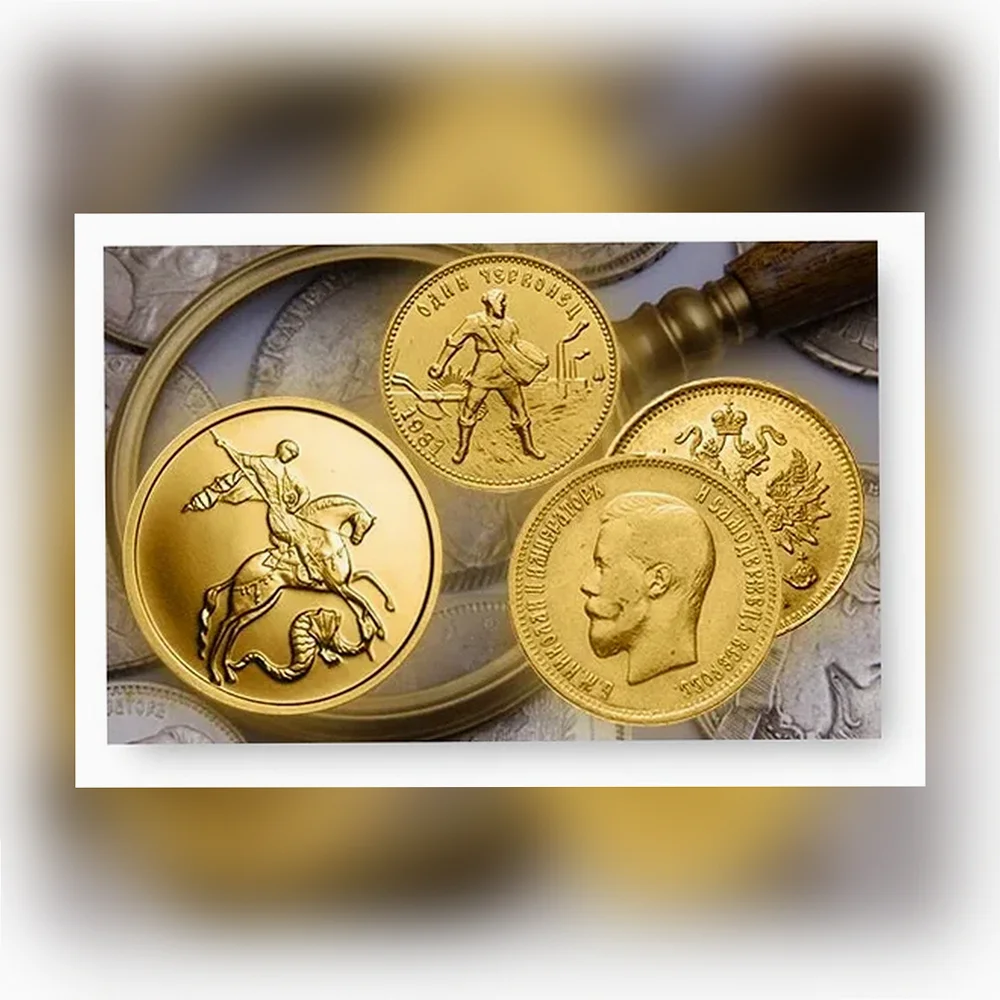

A Golden Shield for Savings: Investment vs. Numismatic Coins
In turbulent times marked by economic crises, physical precious metals traditionally serve as protective assets. Among the various forms of precious metal investments, coins hold a special place.
The question of preserving and multiplying savings has always been relevant, but today, against the backdrop of bank license revocations, tightening Western sanctions, and rising inflation, it has become particularly acute. There are not many alternatives for reliable investment: bank deposits offer ever-decreasing interest rates that cannot keep pace with price increases, and earning on securities requires professional skills and continuous portfolio management.
Only consistently appreciating precious metals can provide reliable protection for savings and potential profit. They are available to the public in the form of investment and numismatic coins.
Types of Precious Metal Coins
In modern Russia, precious metal coins are divided into two main categories:
- Investment
- Numismatic (also known as collector's, commemorative, jubilee, etc.)
Regardless of the category, coins can be made from gold, silver, palladium, platinum, or be a combination of two or more precious metals.
Investment Coins: Pricing and Profitability Basis
The main difference between bullion, or investment, coins and collector's coins lies in their pricing. The value of such coins depends directly and solely on the current market price of the metal from which they are made.
This means that a gold investment coin will be worth exactly the same as the weight of gold it contains. Investment coins do not have commemorative or artistic value and do not carry a rarity premium.
They are mass-produced, and the quality of minting most often corresponds to the 'uncirculated' standard, indicating that the coins have not been in circulation.
The price dynamics of investment pieces precisely mirror changes in the world market quotations of the corresponding precious metal. Gold and silver show slow but steady growth, which guarantees similar long-term returns for coins made from them.
Numismatic Coins: Value Beyond the Metal
Unlike investment coins, the value of numismatic coins is determined by their collectible, artistic, or commemorative value and does not directly depend on current market prices of precious metals. The price of numismatic pieces can be many times higher than their face value and the cost of the precious metal they contain.
They are issued in limited editions, with improved 'proof' minting quality, and are often used as gifts or collector's items.
The common misconception that numismatic coins are not suitable for profitable investments and are only intended for speculation within a narrow circle of professional collectors is false. However, they require a qualified approach and a deep dive into the subject. To work with numismatic currency, one must learn to select specimens, analyze their prospects, and ensure their preservation. The profitability of such investments largely depends on intuition and luck, and quick profits or urgent cash conversion are usually not possible; patience will be required here.
Interestingly, coins that were previously considered investment coins, such as imperial gold chervonets or Soviet 'Sower' coins, acquire numismatic and even historical value over time. The latter can become an obstacle to their international trade.
The opposite metamorphosis can also occur: numismatic specimens that have lost their pristine appearance and collectible value due to improper storage or damage automatically transition into the category of investment coins. The only exception is metal currency from pre-Petrine times, whose historical value does not depend on its condition.
Risks of Investing in Numismatics
Investing in numismatic coins can be compared to a masterful game of preference or poker. Success can only be achieved with patience and attentiveness over many consecutive hands.
Compared to investment coins, seller and manufacturer markups, as well as transaction costs when acquiring numismatic items, are significantly higher. This is due to their highest quality, rarity, aesthetic value component, and small mintage numbers, which sometimes do not exceed 3,000 – 5,000 pieces.
To sell a numismatic coin at a desired price, one must search for a specific buyer who needs that particular item for a long time. If collectible and commemorative money is acquired from banks, then in the event of an economic crisis or serious political instability, their price drops sharply, tending towards the value of the precious metal itself.
Advantages and Transparency of Investment Coins
If buying numismatic money is associated with preference, accessible only to the chosen few, then investing in investment coins to preserve savings and make a profit is more like a game of chess. Deliberate actions and the absence of meaningless sacrifice of pieces are important here. If you are tired, you can postpone the game and continue it later with the same board situation.
Today, the investment coin market is vast and active. There will always be a buyer for your goods offering a good price. Often, after buying coins at one bank, you can find another institution just a few blocks away and sell them for a significant profit. Here, market laws apply, not the rules of secret numismatic societies or elite knightly orders of collectors.
In almost any country, for coins like George the Victorious or The Sower, any dealer will be ready to offer a good price. The usual markup is about 7% of the value of the precious metal contained in the coin. It only approaches zero in the event of major geopolitical and economic upheavals, but the value of the precious metal itself is preserved, and there is confidence that as the global situation improves, the price of investment coins will rise again.
If you show patience, even a crisis can bring profit. It is enough to sell futures for the corresponding weight of gold or silver in investment coins and wait. Usually, the situation improves within six months, allowing you to profit from almost anything.
Popular investment coins today are sold with direct reference to the world market price of the precious metal. This market is characterized by simplicity, clarity, and transparency, with price fluctuations typically not exceeding 10%. Thanks to straightforward patterns, one can always quickly and objectively determine the fairness of any given price offer.
For example, for gold investment coins, it's enough to multiply the cost of one ounce of gold in dollars by the current exchange rate of the American currency to rubles and divide by the number of grams in an ounce (31.1035). When trading, the weight and cost of the precious metal are always paramount. The current price of coins may be lower due to defects and damage, but over time, these might contribute to an increase in value due to rarity.
Comparison Table: Investment vs. Numismatic Coins
| Criterion | Investment Coins | Numismatic Coins |
| Pricing | Direct dependence on the market price of the metal | Depends on collectible, artistic, commemorative value |
| Additional Value | Absent (commemorative, artistic, rarity) | Can be many times higher than the cost of the metal and face value |
| Mintage | Mass production | Limited editions (sometimes 3000-5000 pcs.) |
| Minting Quality | «Uncirculated» (never been in circulation) | Improved «proof» quality |
| Investment Approach | Simple, transparent, long-term | Requires qualified analysis, intuition, patience |
| Liquidity | High, always a buyer, simple price calculation | Low, difficult to find a specific buyer, slow conversion |
| Seller's Mark-up | Around 7% of the metal's value | Significantly higher |
| Price Dynamics in Crisis | Tends towards the metal's value, then recovers | Drops sharply to the metal's value |
