
Why Measure Coin Weight?
Knowing the weight of coins opens the door to a deep understanding of their history and value. For gold and silver currency, checking their mass is one of the most accessible methods to detect counterfeits. As for everyday Russian coins, their weight serves as an important indicator of changes in monetary policy and the development of minting technology.
Throughout the history of Russian coins, their weight has changed repeatedly, often for various reasons. For instance, Peter I once reduced the mass of a silver kopeck from approximately 0.44 grams to 0.28 grams. This was done to establish a clear ratio: one ruble was to equal 100 kopecks, which corresponded to 28 grams of silver.
Similar attempts were made earlier by Alexei Mikhailovich, but his ruble, re-minted from a thaler, effectively cost 64 kopecks, which led to low public trust. In Soviet times, starting from the 19..., coins of small denominations — 1, 2, 3, and 5 kopecks — had a weight equal to their face value: 1, 2, 3, and 5 grams respectively. Today, we can examine the mass of modern currency and the metals from which they are produced.
Modern Russian Coins: Weight and Materials
| Denomination | Weight | Diameter | Material |
| 1 Kopeck | 1.5 g | 15.5 mm | Steel, clad with cupronickel |
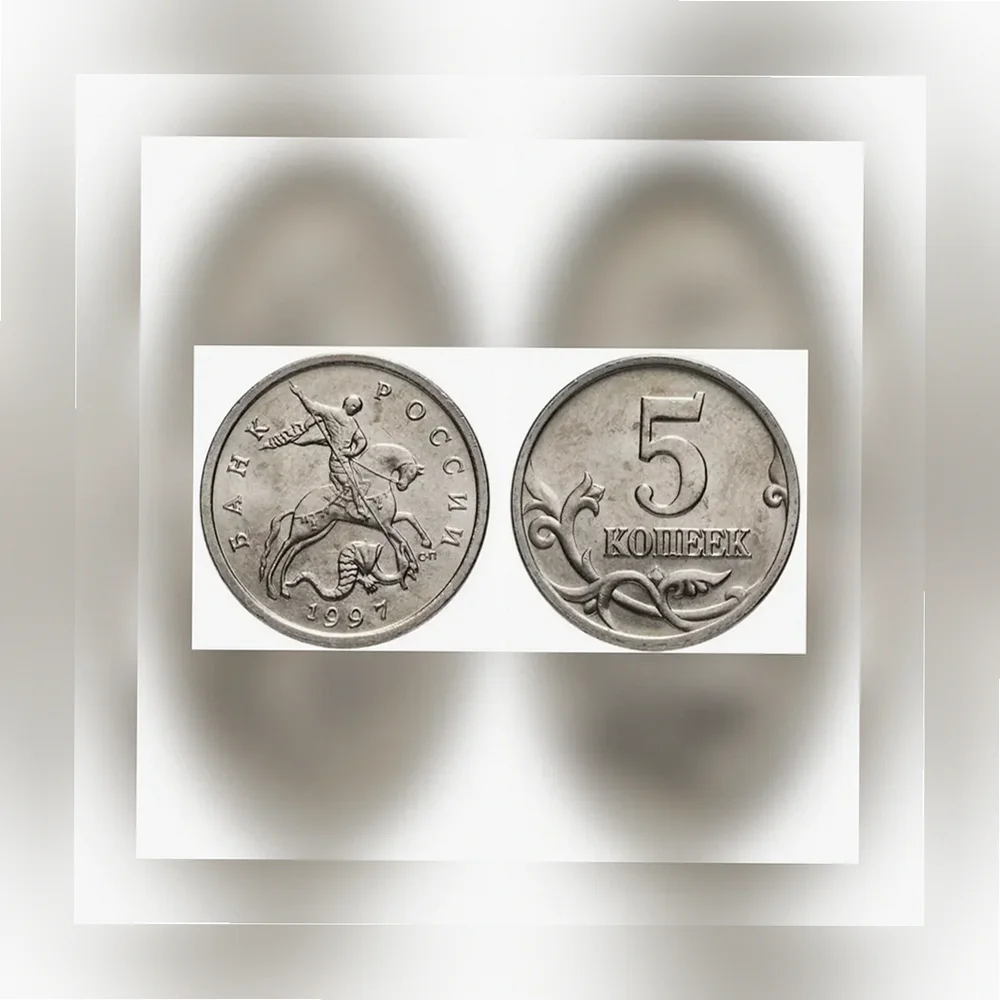
| 5 Kopecks | 2.6 g | 18.5 mm | Steel, clad with cupronickel |
| 10 Kopecks (1997) | 1.95 g | 17.5 mm | Brass |
| 10 Kopecks (2006) | 1.85 g | 17.5 mm | Steel, copper-plated on both sides (tompac alloy) |
| 50 Kopecks (1997) | 2.9 g | 19.5 mm | Brass |
| 50 Kopecks (2006) | 2.75 g | 19.5 mm | Steel, plated with tompac alloy on both sides; since 2015 — steel with galvanic brass coating. |
| 1 Ruble (1997) | 3.25 g | 20.5 mm | Copper-nickel alloy |
| 1 Ruble (2009) | 3 g | 20.5 mm | Steel with nickel electroplating |
| 2 Rubles (1997) | 5.1 g | 23 mm | Copper-nickel alloy |
| 2 Rubles (2009) | 5 g | 23 mm | Steel with nickel electroplating |
| 5 Rubles (1997) | 6.45 g | 25 mm | Copper, clad with cupronickel |
| 5 Rubles (2009) | 6 g | 25 mm | Steel with nickel electroplating |
| 10 Rubles (1997) | 5.63 g | 22 mm | Steel with brass electroplating |
Starting in 2009, everyday Russian coins began to be minted from more economical steel, coated with nickel or brass. This transition was undertaken to reduce production costs. According to available calculations, the cost of minting one kopeck was 461% higher than its face value. Since 2016, the regular production of coins with a denomination of less than one ruble has been discontinued.
Historical Weight: From Tiny Scales to Giant Plates
Weight of a 1 Kopeck Coin
The smallest denomination coin — the 1 kopeck — in its modern form weighs only 1.5 grams. This weight is characteristic of specimens issued since 1997, which are made of steel clad with cupronickel. The lightest coins in the history of Russian coinage were the silver 'scales' from the time of Peter I, with a mass of only 0.28 grams.
In contrast, the heaviest copper kopeck is considered to be the coin from the time of Elizabeth Petrovna, issued in 1755–1757. Its weight exceeded 20 grams, making it quite impressive for its denomination.
Weight of the 5 Kopeck Coin
Modern 5 kopeck coins from the 1997 issue weigh 2.6 grams. Throughout the history of these 'pyataks' (fivers), their mass has changed repeatedly. Among the heaviest are the copper plates of Catherine I, dated 1726.
These square coins, with sides of 45 millimeters, were striking in their weight, reaching 81 grams, making them true giants among Russian coins.
Weight of the 10 Kopeck Coin
10 kopeck coins from the 1997 issue weigh 1.95 grams. After switching to steel clad with a tompack alloy, their mass became slightly less — 1.85 grams. The heaviest, likely, were also the copper plates of Catherine I.
These massive square coins had sides of 65 millimeters and an impressive weight of 163.8 grams. Among classic round Russian coins, it is worth mentioning the Siberian 10 kopecks, which were minted at the Suzun Mint starting in 1766. The diameter of this copper coin was 45 millimeters, and its weight was 65.5 grams.
Weight of the 50 Kopeck Coin
Modern 'poltinniks' (50-kopeck coins) weigh 2.75 grams. When they were minted from brass, they were slightly heavier, their mass being 2.9 grams. Silver 50 kopecks of the 19th century and similar coins issued after the collapse of the Russian Empire weighed 10 grams.
The heaviest in the history of this denomination were copper plates — half a ruble or 'poltina'. This was a square with sides of 139 millimeters and a colossal weight of 819 grams.
Weight of a 1 Ruble Coin
A modern ruble made of steel with nickel electroplating weighs 3 grams; the copper-nickel alloy version weighs 3.25 grams. However, in the history of Russia, there were also true giant rubles.
Copper plates rank first in weight: a square 1 ruble coin weighed 1.638 kilograms, with one side measuring 188 millimeters. Second in massiveness is the Sestroretsk ruble — a series of trial coins issued under Catherine II in 1770.
In shape, this coin more closely resembled a puck, with a thickness of 28 millimeters, a diameter of 72.5 millimeters, and a weight that could reach up to 1 kilogram.
Weight of a 2 Ruble Coin
Two-ruble coins made of steel with nickel electroplating weigh 5 grams, while their 1997 copper-nickel alloy versions weigh 5.1 grams. Historically, 'two-ruble' coins also typically weighed within the range of 4-5 grams.
The heaviest two-ruble coins are issued as part of commemorative series, such as 'Outstanding Personalities of Russia' or 'Red Book'. For instance, the silver coin 'Church-Metochion of St. Nicholas the Wonderworker in Bari' weighs 22.26 grams.
Weight of a 5 Ruble Coin
Five-ruble coins made of steel with nickel electroplating weigh 6 grams, while those made of copper clad with cupronickel weigh 6.45 grams. In the USSR, the largest and heaviest coin of this denomination was the commemorative '70 Years of the Great October Socialist Revolution'.
Its weight was 29 grams with a diameter of 39 millimeters. The five-ruble coins from the 'Golden Ring' series of 2004 were almost twice as heavy. They were the first coins made from two precious metals — silver and gold — and weighed approximately 48 grams.
Weight of a 10 Ruble Coin
Ten-ruble coins made of steel with brass electroplating weigh 5.63 grams. Overall, this denomination shows no significant weight discrepancies in modern minting. Tsarist gold imperials weighed about 13 grams.
Slightly more, 15.55 grams, is the weight of commemorative palladium coins issued between 1992 and 1995, such as those from the 'Russian Ballet' series.
Weight of a 25 Ruble Coin
Twenty-five-ruble coins are typically issued as part of commemorative series, such as 'Sochi-2014' or '300th Anniversary of Peter I's Monetary Reform'. Their weight varies depending on the chosen metal and the minting method used.
Among them, the heaviest are gold coins, of which only 100 pieces were minted for the son of Emperor Alexander II, Grand Duke Vladimir Alexandrovich. The average weight of one such coin was 32.7 grams.
The Evolution of Convenience: Why Modern Weight is So Important
History has shown that excessively heavy currency was not popular among the population, while lightweight currency was easy to lose. This is why modern circulating rubles and kopecks are made from metals that are resistant to wear and corrosion.
These Russian coins are moderately light, making them convenient for daily carrying. Their optimal weight and durability ensure their practicality in circulation.
