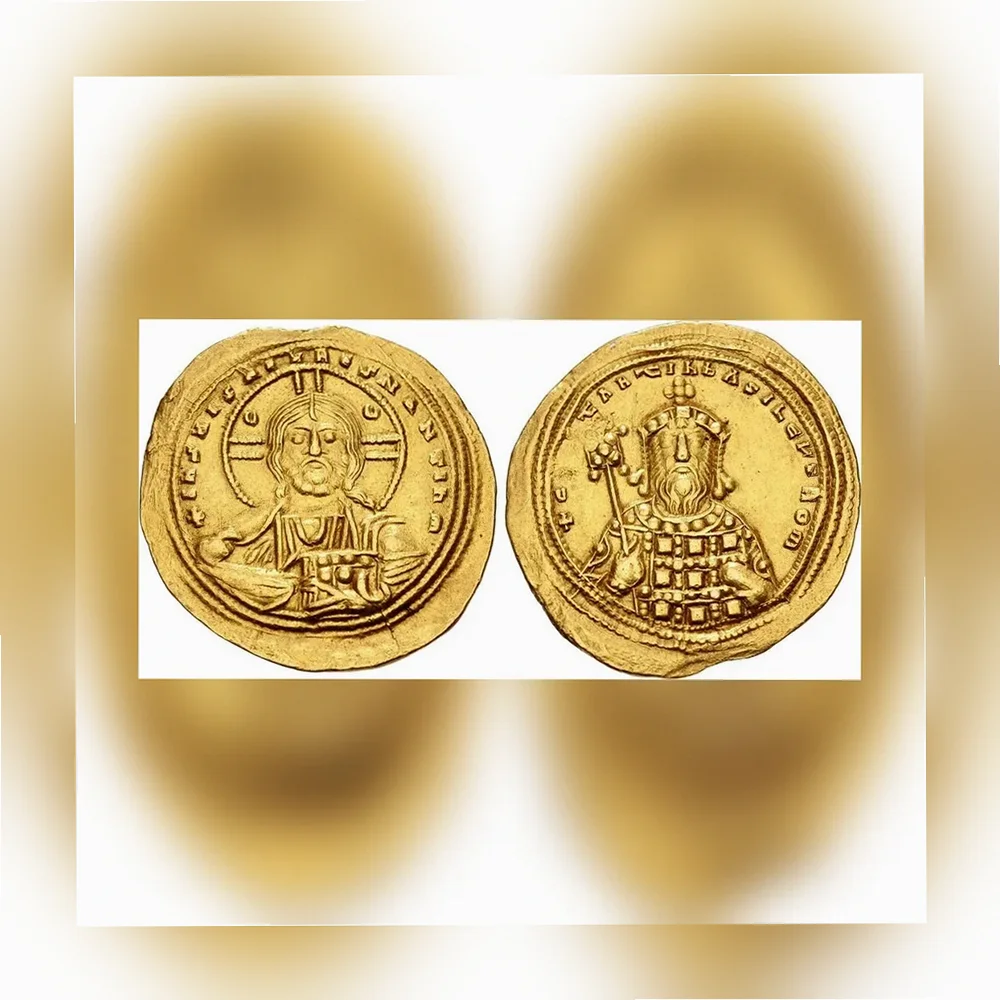

From the Gold Standard to the 'Dollar of the Middle Ages'
Byzantine coins, especially the gold solidus, served as the global financial standard for centuries. This valuable currency, known in Greek as nomisma, first appeared under Constantine the Great in the 4th century AD.
It remained the benchmark for almost a thousand years, enjoying immense trust among merchants and states from London to Baghdad. It's no wonder historians often call it the 'dollar of the Middle Ages,' emphasizing its universal recognition and influence.
The Birth of the Solidus: The Roman Empire's Gold Standard
The gold solidus (Latin: solidus) was first introduced by Diocletian as a rare, high-purity coin in the late 3rd century, as part of his monetary reform. However, it was Constantine I the Great, around 312 AD, who transformed the solidus into the primary gold currency of the Roman Empire.
This was necessary after the profound monetary crisis of 235–284 AD, when the aureus rapidly lost weight, and silver coins almost entirely lost their silver content, causing inflation. By the end of the 3rd century, copper coins were being passed off as silver, and gold coinage was also in a deplorable state.
Diocletian attempted to stabilize the situation, but failed to achieve widespread gold circulation. Constantine I brought the reform to completion: he established a fixed weight for the solidus (1/72 of a Roman pound ≈ 4.5 g), maintained an almost pure fineness, and centralized coinage.
For the first time in a century, the empire received a stable gold coin, which became the foundation of trade and finance for the next seven centuries.
Key Parameters of Gold Stability
The characteristics of the solidus remained almost unchanged for about seven centuries, ensuring its reliability. Here are its key parameters:
- **Weight:** approximately 4.5 g of gold, which was 1/72 of a Roman pound.
- **Purity:** close to 24 karats, meaning almost pure gold.
- **Fixed exchange rate:** 1 solidus was exchanged for 24 siliquae (silver coins).
Coins made of soft precious metal wore out quickly, so they were melted down immediately upon arrival at the treasury to prevent inferior solidi from circulating. As a result, the currency was accepted in various countries, including the territory of modern Russia, as evidenced by numerous archaeological finds.
In addition to gold, bronze coins circulated and were used in everyday trade. They did not have the stability of the solidus and were more prone to devaluation, but it was bronze that ensured the main volume of small transactions within the empire.
In the late empire, gold solidi, silver miliarisia and siliquae, as well as small nummi – bronze or copper coins – were issued. The ratio between them was as follows:
| Coin | Metal | Ratio to Solidus |
| Solidus | Gold | 1 |
| Miliarision | Silver | 1/12 |
| Siliqua | Silver | 1/24 |
| Nummus | Bronze/Copper | 1/180 |
From Solidus to Nomisma: The Main Currency of the Middle Ages
When the Western Roman Empire collapsed in the second half of the 5th century, the Eastern part continued its existence as Byzantium. The Latin name of the coin, "solidus," gradually changed to the Greek: nomisma (from νόμισμα — coin).
Inscriptions on the currency remained Latin until the 8th century, and were finally replaced by Greek script in the early 9th century. By the 10th–11th centuries, the system became slightly more complex, with two main varieties emerging:
- **Histamenon nomisma:** the "full-weight" nomisma, close to the old solidus (4.5 g).
- **Tetarteron nomisma:** a lighter variant, slightly thinner and lighter (4.05 g), typically used for trade with other countries.
Throughout this period, Byzantine gold remained the international reserve currency. It was used to pay for silk, spices, mercenaries, and also served as a standard for other coins. For example, Islamic dinars were modeled after the nomisma. In addition to these, the empire used silver (hexagram, siliqua, etc.) and bronze coins (nummus).
Decline of the Golden Age: Debasement and Reform
The situation changed in the 11th century. Emperor Michael IV the Paphlagonian, a former money changer, came to power and began a gradual debasement. Researchers record the decline in gold content:
| Emperor | Gold Content |
| Constantine IX | Up to ~21 carats (87.5 %) |
| Constantine X | Up to 18 carats (75 %) |
| Romanos IV | Up to 16 carats (66.7 %) |
When Alexios I Komnenos came to power (1081), the gold content in the nomisma varied from 0 to 8 carats (33%). Therefore, in 1092, Alexios carried out a monetary reform: he abolished the old nomisma and introduced a new gold standard — the hyperpyron.
It weighed approximately 4.45 g and had a fineness of ~20.5 carats (about 85% gold). The hyperpyron remained the main gold coin until the mid-14th century.
Art and Symbolism: Images on Imperial Coins
Byzantine gold coins were not only money but also a kind of political 'social network' for the emperors. Early solidi from the time of Constantine and his successors typically featured a bust of the emperor in armor, with a laurel wreath or diadem, turned in ¾ profile.
The reverse featured the figure of Victory (Victoria) in profile, supporting a cross. These images emphasized the legitimacy of the new dynasty and military power. After the official establishment of Christianity under Emperor Theodosius (379-395 AD), coins gradually became filled with religious symbolism.
For example, the Byzantine ruler Justin I changed the image on the obverse, introducing a frontal bust facing the viewer. Simultaneously, on the reverse, the ancient goddess Victory gave way to an angel, also depicted en face, which emphasized the transition of the Byzantine Empire to Christian iconography.
By the 7th–8th centuries, iconography became even bolder. On the gold coins of Justinian II, the face of Christ in human form appeared for the first time: on the obverse, while the emperor moved his own image to the reverse. Researchers link this to the decisions of the Council in Trullo (Canon 82), which recommended depicting Christ specifically as a human, and not only through symbols (lamb, cross, etc.).
Thanks to this program, coins functioned like miniature icons: they were seen by soldiers, merchants, and pilgrims. In an era when few people were literate, it was money that conveyed the image of the 'correct' emperor and the 'correct' faith to the general public.
From the mid-8th century, the veneration of icons was forbidden, so God was no longer minted, and facial images on coins became simplified. Only under Michael III (842–867) did Christ return to the coinage. The legend 'rex regnantium' ('king of kings') indicated that God ruled people through the emperor as His successor on earth.
Interestingly, Byzantine artists did not attempt to capture the facial features of rulers. This was due to their worldview: the image of the emperor was understood not as a physical portrait, but as an image of his 'eternal body' — the sacred essence of power granted from above. Therefore, coin portraits of different rulers appear almost identical.
On a rare gold coin of Zoe and Theodora, daughters of Constantine VIII (1042 AD), the Virgin Mary is depicted with hands raised in prayer. Another interesting coin was minted under Romanos IV (1068–1071), on which Christ is shown standing between the emperor and empress.
With the reconquest of Constantinople, Michael VIII introduced a new image: the Theotokos (Mother of God) ascending above the city walls. On the reverse, the emperor is depicted kneeling before Christ. This scene would later become a dominant motif. By the mid-14th century, the design had changed little, but the coins lost value — marking the final stage of Byzantine gold coinage.
Twilight of the Golden Age: How Debasement Destroyed an Empire
As long as the solidus/nomisma remained the 'gold standard,' Byzantium could afford expensive mercenaries, extensive diplomacy, and active foreign trade. The financial system withstood military defeats and unsuccessful reigns.
However, a crisis began in the 11th century when the treasury was drained by court expenses, war, and gifts to allies. The state gradually lost revenue-generating provinces, and gold was exported to other countries. Rulers began to reduce the precious metal content in coins, leading to a loss of trust.
The reform of Alexios I Komnenos and the introduction of the hyperpyron stabilized the situation, but only for a short time. After the capture and sacking of Constantinople by the Crusaders in 1204, gold coinage in the capital virtually ceased. Production shifted to the provinces — primarily to the Empire of Nicaea and the state in Magnesia on the Hermus, where mints still existed.
However, gold issues could no longer match their former volume and quality: coins were minted less and less frequently, and their standard rapidly deteriorated. According to the Florentine merchant Pegolotti, in the early 14th century, a dozen varieties of devalued hyperpyra were in circulation.
This clearly reflects the degree of decomposition of the empire's monetary system. Simultaneously, the role of silver increased, gradually displacing gold as the primary metal for coinage. By this time, the Byzantine coin had lost its significance as an international currency: in the Eastern Mediterranean, its place was taken by the Islamic dinar.
This became the definitive sign that the empire's former financial power was a thing of the past.
Financial Ecosystem: A Guarantee of Stability
The stability of the solidus and nomisma was due not only to their high gold content. Byzantium built an entire financial ecosystem around the coin. It included several key elements:
- Strict control over metal extraction.
- Regular payments to the army.
- Well-thought-out taxes.
- Active foreign trade.
The state virtually monopolized coinage, preventing local authorities from issuing their own gold currency. This avoided the chaos characteristic of barbarian kingdoms. That's why the solidus was accepted without verification: merchants knew that a coin from Constantinople would always have the same weight and purity.
This predictability formed Byzantium's unique financial zone, where the solidus served as a tool for transactions from the coast of Syria to the markets of Western Europe. Even when the political map changed, Byzantine coins set the standard by which neighbors oriented themselves.
And it was only when the empire lost control over its resources and territory that the economy, along with the monetary system, began to crumble, marking the end of the golden age of Byzantine currency.
