
Gold: Eternal Value and Modern Investment Avenues
Gold undeniably remains one of the most renowned and coveted precious metals in the world. Modern technologies offer investors numerous opportunities to invest in this unique asset, providing diverse approaches to preserving and growing capital.
Historically, gold has served as a universal symbol of wealth and power. Its beauty and rarity attracted ancient civilizations, which used the metal to create decorative ornaments, jewelry, and the first forms of money. This allure to gold has not diminished today.
Over millennia, the value of gold has practically not diminished. Although most currency systems are no longer tied to the gold standard, the metal continues to act as a hedge against fiat currencies. Gold retains its intrinsic value because its supply is limited and cannot be artificially increased, unlike paper money.
Gold's appeal makes it a sought-after alternative for those looking to diversify investments and spread risks. There are many ways to acquire gold — both for ornamentation and as an investment tool. For many, it also serves as protection against economic turmoil, wars, inflation, and global uncertainty.
Characteristics of Gold as an Asset
Before purchasing gold, it's important to understand some of its unique characteristics. Investing in gold can be an excellent addition to a portfolio, including the accumulation of physical assets like gold coins, bars, and jewelry.
There are also less traditional methods, such as vending machines that dispense gold for cash, which have already appeared in some locations. Additionally, investors can gain indirect exposure to gold through shares of gold mining companies, mutual funds, and exchange-traded funds (ETFs).
| Item Type | Gold Purity (carat) | Gold Content Percentage |
| Modern Coins | 90–99% | 90–99% |
| Jewelry (USA) | 14 | 58% |
| Jewelry (Rest of the World) | 18 | 75% |
| High Purity Jewelry | 24 | 100% |
However, it is worth noting that gold does not provide a regular income stream unless you own stocks or mutual funds that pay dividends. Securities of gold mining companies do not grant ownership of physical gold, and storing the metal itself entails additional costs.
Despite limited current supply, rising prices can make extraction more economically viable, potentially increasing production. The demand for gold is not always driven by true industrial need, as a large portion of it is used for jewelry manufacturing and investment purposes. A significant share of gold reserves is held by governments and central banks, which can cause extreme price fluctuations when they buy or sell.
Gold Coins: History and Modernity
Gold investment coins are minted by many countries worldwide. Although they are legal tender, the value of the metal contained within them significantly exceeds their face value.
Investment and Collectible Coins
The market price of many numismatic, or collectible, coins can be even higher. Collectors are attracted by the potential for value appreciation, which is based on the coin's rarity and demand.
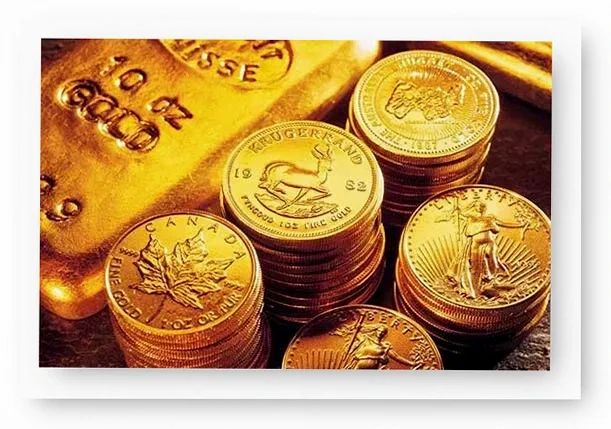
Modern coins are readily available, and their purity is guaranteed by state mints. Among the most popular options are:
- American Eagle
- Canadian Maple Leaf
- South African Krugerrand
- Vienna Philharmonic
- Mexican Gold 50 Pesos
- British Sovereign
- Australian Kangaroo
- American 24-Karat Buffalo
Some of these coins are available in various sizes, allowing them to meet the demand of both large and small investors. For example, the weight of an American Eagle ranges from one-tenth to one ounce.
Legendary Coins of the Past
Liberty coins, issued until 1933, were the only coins minted by all seven active U.S. mints at the time. Their production ceased in the same year that President Franklin Roosevelt signed an order to confiscate gold from Americans in response to the accumulation of the metal during the Great Depression, with the exception of coins of recognized numismatic value.
Many American investors prefer old coins, fearing another government gold confiscation, and assume that collectible specimens might again escape such a fate. Among the popular and readily available coins from dealers are the Half Eagle ($5) and the Eagle ($10).
The Double Eagle ($20) is arguably the most recognizable and coveted of early gold coins. One of the most captivating and famous is the Saint-Gaudens coin, commissioned by President Theodore Roosevelt and designed by the celebrated sculptor Augustus Saint-Gaudens.
Antique coins minted in other countries, including Great Britain, South Africa, China, Spain, and Mexico, are also very popular.
Gold Bars: From Gram to Ton
Many imagine gold bars as enormous chunks of metal stored in Fort Knox, but they exist in a wide variety of shapes, weights, and purity levels.
A gold bar can be in the form of a rectangular ingot, a coin-like round piece, or any other shape suitable for sale. Its price typically includes the cost of the metal itself, processing and delivery fees, and the dealer's premium.
Bars vary in weight, starting from 1 gram. Heavier bars are more convenient for large investors, as storing them in specialized, insured precious metals facilities is more practical. Buying larger bars also helps save on some additional costs.
However, large bars have their drawbacks: they are harder to sell and use as a means of barter. Both state mints and private companies produce bars, including:
- Johnson Matthey
- Wall Street Mint
- Sunshine Minting
- Credit-Suisse
- Engelhard
- PAMP
Investments in Stocks and Funds
Beyond physical gold, there are other ways to invest in this precious metal, for example, through securities. The main advantages of stocks and exchange-traded funds (ETFs) include the absence of storage issues for the metal and the potential for dividend income.
Gold Mining Company Stocks
Investors can purchase shares of individual gold mining companies or invest in mutual funds that partially or fully invest in these companies. Such funds can provide diversification by including other precious metals like platinum, palladium, and silver.
The option to acquire options on gold futures contracts at a set strike price is also available. However, it's worth remembering that gold stocks do not always move in full alignment with spot gold prices, as the success of mining companies depends on their individual production performance. Furthermore, there is no guarantee of owning physical gold if the company whose shares were purchased performs poorly.
Exchange-Traded Funds (ETFs)
ETFs hold gold bullion on behalf of their clients. One of the most well-known traded investment funds is the SPDR Gold Trust, also known as 'Spider' with the ticker GLD. These funds are traded throughout the day,
