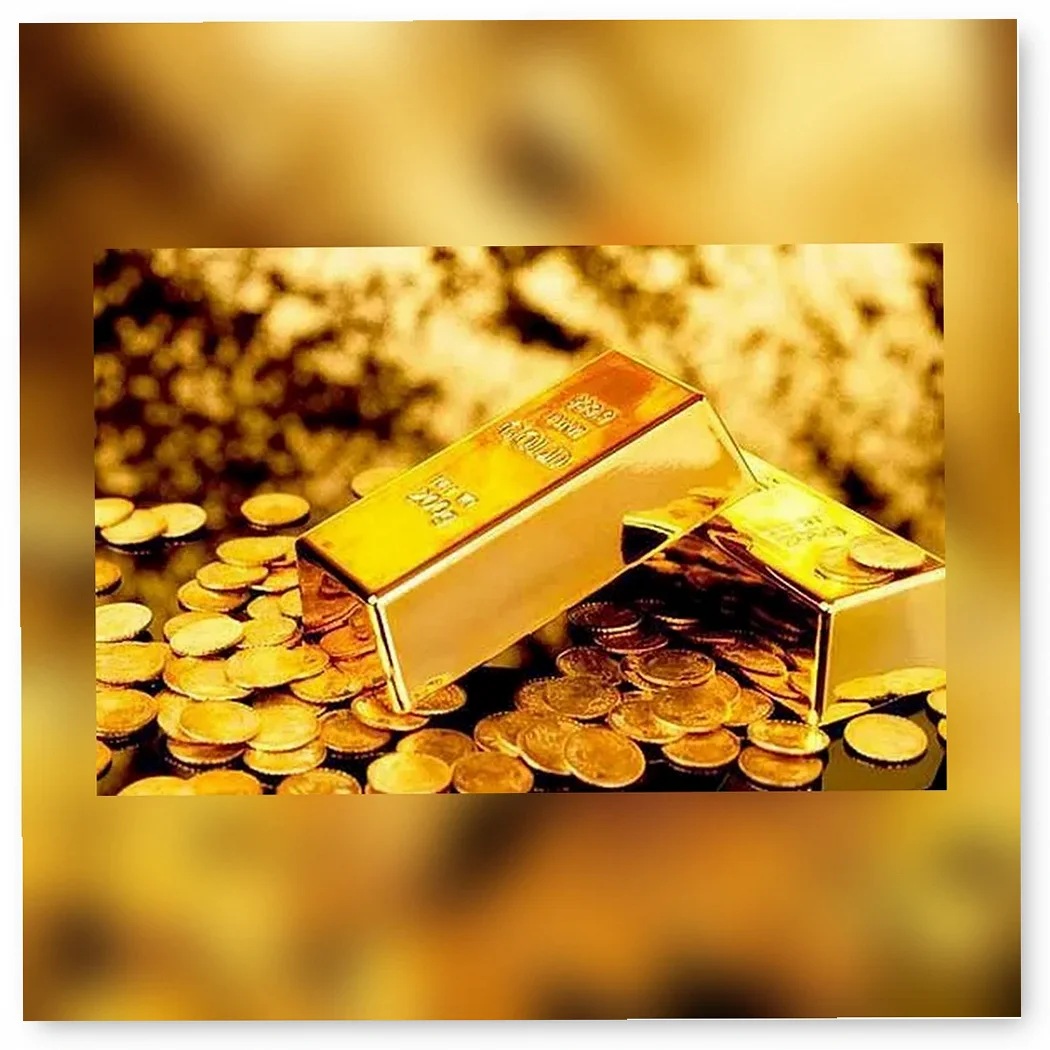

Gold: Timeless Magnetism
'Mr. Bond, I've been in love with gold all my life. I love its colour, its shine, its divine weight... I ask you, is there any other substance that so rewards its owner?' This phrase, spoken by Auric Goldfinger in dialogue with James Bond, perfectly reflects humanity's deep and long-standing fascination with gold.
To understand this enduring passion, one doesn't need to be a criminal mastermind. The craving for gold is rooted in history and remains one of the strongest to this day. The lasting value of this precious metal is primarily due to its extreme scarcity.
Rarity and Cosmic Origin of the Precious Metal
Gold makes up only one five-hundred-millionth of the Earth's crust, making it truly unique. All the gold ever mined could fit into a cube with sides of just 22 meters. This fact underscores its incredible rarity among all known elements.
Gold formed billions of years ago as a result of powerful explosions within or between stars. Some of these deposits ended up in the Earth's core during its formation, while others were delivered to the planet's surface by asteroids.
Ultimately, this precious metal became buried under mountain ranges, hidden beneath seas, and scattered across waterways worldwide. Current estimates suggest that about 50,000 tons of gold, with a total value exceeding 2 billion pounds sterling, are yet to be found on Earth.
Amazing Properties: Weight, Flexibility, and Immortality of Gold
Gold possesses a range of unique physical properties that set it apart from other metals. A standard gold bar weighs about 12 kilograms, which is nearly twice as dense as lead, highlighting its exceptional weight.
Despite its impressive weight, gold is surprisingly flexible. Just one ounce of the precious metal can be drawn into a wire up to five miles long or rolled into a sheet one hundred times thinner than ordinary paper, demonstrating its incredible malleability.
| Property | Description |
| Density | Nearly twice as dense as lead; a standard bar weighs about 12 kg |
| Flexibility | An ounce can be drawn into a 5-mile wire or rolled into a sheet 100 times thinner than paper |
| Durability | Does not corrode, rust, or decompose |
| Reusability | Infinitely usable; may have belonged to historical figures |
Unlike most materials, gold does not corrode, rust, or decompose, making it virtually eternal. This property ensures its infinite reusability. It is entirely possible that gold jewelry worn today once belonged to historical figures such as King Solomon or Cleopatra.
From Gods to Kings: The Age-Old Symbolism of Gold
Many ancient societies perceived gold as a divine metal. The Egyptians called it the 'flesh of the gods,' while the Incas considered it the 'sweat' or 'tears' of the sun. These associations with the sun have not disappeared to this day, permeating culture and symbolism.
Our chemical symbol for gold, Au, comes from the Latin word 'aurum,' which in turn originated from 'aurora,' meaning 'dawn.' This connection to the morning light emphasizes its radiant and life-giving nature.
Rulers throughout the centuries, from Tutankhamun to Midas, from Augustus the Strong to Louis, the Sun King, chose to surround themselves with gold. Its incessantly shining surface served as a fitting metaphor for immortality. This is why, more than 2000 years ago, gold was presented to an infant in a manger who, like the morning sun, later rose from the dead.
The Age-Old Hunt: From El Dorado to Alchemical Laboratories
Human history is strewn with tales of those who sought to obtain gold and, typically, failed. Spanish conquistadors spent vast sums and shed much blood, traveling through South America in search of the legendary El Dorado, where, according to legend, gold was as abundant as water.
Others sought to produce gold in laboratory settings. This goal became the driving force behind alchemy, which dominated science and philosophy in parts of the world for millennia. Alchemists passionately desired to find the 'philosopher's stone' — a wondrous material they believed could transform base metals into gold.
Modern Times: Gold is Created, But at a Cost of Quadrillions
Modern scientists have achieved what their alchemist ancestors could not. Over the past 40 years, using particle accelerators and nuclear reactors, they have managed to reproduce the process that giant stars carried out billions of years ago.
Thus, atoms of bismuth, platinum, and mercury are transformed into tiny amounts of gold. However, producing just one ounce of gold by this method costs one quadrillion dollars. This astronomical cost makes it virtually impractical for mass production.
Perhaps it is much simpler, as Goldfinger observed, "to raid the local gold depository" than to produce it through such an expensive scientific method. This merely underscores the enduring value and rarity of this unique precious metal.
