
Investing in Physical Precious Metals: Bullion or Coins?
In the Russian Federation, there are two main avenues for those looking to invest capital in physical precious metals: acquiring precious metals in the form of bullion bars or purchasing investment coins.
Investment coins are considered the most convenient instrument for investing capital in physical gold. Their value is as close as possible to the price of the metal itself, which distinguishes them from antique or commemorative coins, whose price is largely determined by their collectible value and rarity.
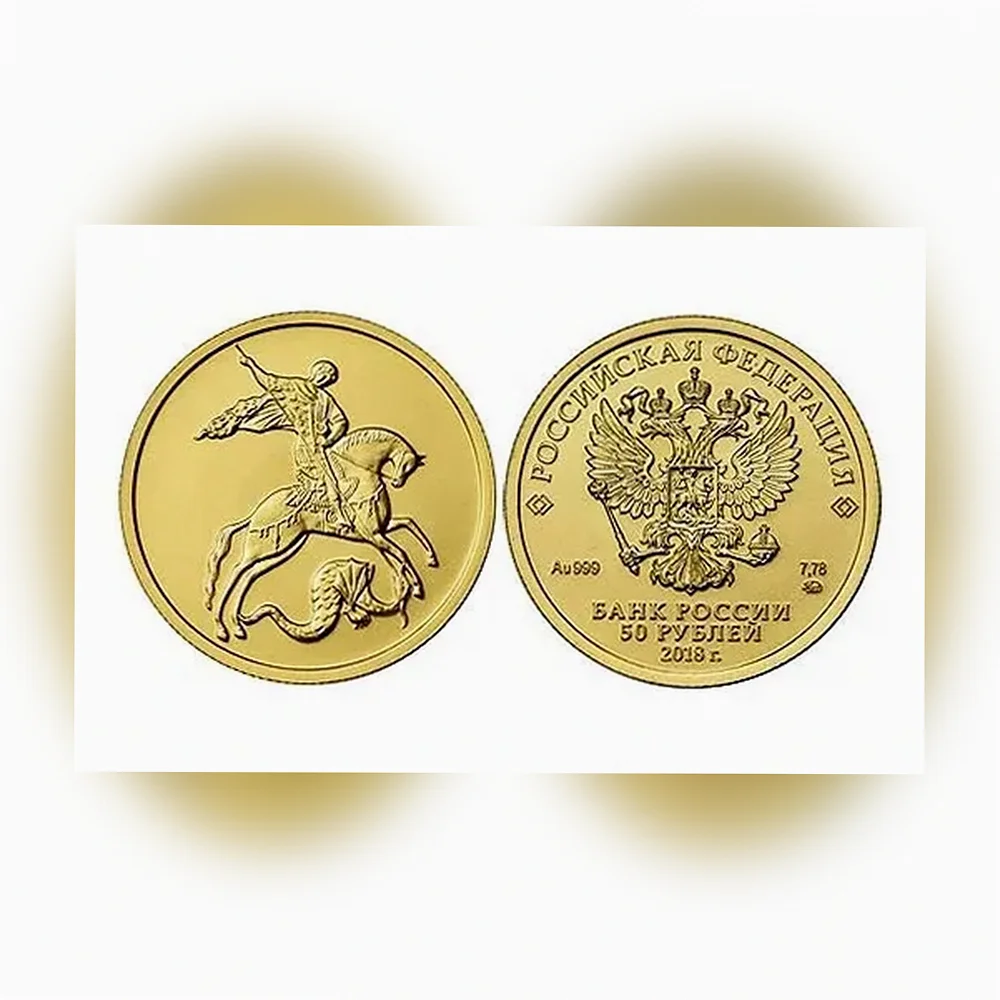
Next, one of the most popular ways to invest in physical gold—through the 'Saint George the Victorious' coin—will be discussed.
Introducing 'Saint George the Victorious'
Among Russian investors, 'Saint George the Victorious' gold coins hold leading positions in terms of popularity and liquidity. These coins are issued by the Central Bank of the Russian Federation and minted at the state mints MMD/SPMD.
'Saint George the Victorious' are the most mass-produced investment coins with a denomination of 50 rubles. They are made from high-purity investment gold, 999 fineness or higher, which indicates a significant content of pure gold.
Price Formation: Calculating the Coin's Value
Unlike currency quotes, which are set by the foreign exchange market and are relatively easy to track, calculating the value of investment coins has its peculiarities. A novice investor is advised to learn how to do it independently.
The ruble price of coins is formed from two key components:
- The weight of pure metal contained in the coin.
- The exchange price of 1 gram of metal in rubles.
The exchange price of 1 gram of metal in rubles, in turn, is determined by the price of 1 ounce of metal on the international exchange in dollars, as well as the ruble to dollar exchange rate. It is worth noting that precious metals are traditionally traded in troy ounces, where one troy ounce is equal to 31.1035 grams.
Let's consider an example of price calculation:
| Parameter | Value |
| Current price of 1 ounce of gold on the exchange | $3,340 |
| Dollar exchange rate | 80 rubles per dollar |
| Weight of a troy ounce | 31.1035 grams |
| Calculation of the price of 1 gram of gold in rubles | 3,340 * 80 / 31.1035 = 8,590 rubles |
| Net weight of gold in the «George the Victorious» coin | 7.78 grams (or 1/4 troy ounce) |
| Exchange price of gold in one coin | 7.78 grams * 8,590 rubles/gram = 66,835 rubles |
Thus, knowing these parameters, one can independently calculate the exchange value of the gold contained in each coin.
The Mystery of the «Exchange Premium»: What else affects the price?
The cost of a physical coin that ends up in the investor's hands is usually higher than the abstract «gold» in large bank bars stored somewhere in London. This is due to the costs of minting, packaging, and delivering the coin to a bank branch or dealer company.
Therefore, coins typically cost 5-15% more than the metal they contain. This phenomenon is called the «exchange premium». For example, the Central Bank of Russia sells the gold «George the Victorious» at a price already 7% higher than the exchange value of the metal.
According to the example above, the Central Bank's selling price for the gold «George» will be: 66,835 * 1.07 = 71,514 rubles per coin.
Yield Dynamics: The 'St. George the Victorious' in Historical Perspective
The long-term growth in the value of gold in dollars and the strengthening of the dollar against the ruble inevitably lead to an increase in the price of gold coins. This can be easily observed by looking at the dynamics of the selling price of the 50-ruble 'St. George the Victorious' coin at the Bank of Russia.
Over the past ten years, from July 2015 to July 2025, the price dynamics of the 'St. George the Victorious' coin significantly outpaced both real estate dynamics and even many stock market shares. During this period, the price of the golden 'St. George' grew from 18,040 to 70,307 rubles, representing an increase of 290%, or almost 3 times.
Prospects for Accelerated Growth: Future Forecasts
The modern global economy has accumulated a colossal volume of debt which, in all likelihood, cannot be repaid without the constant 'printing' of new money. When the global economy enters another phase of slowdown, which occurs cyclically every 10-15 years (last observed in 2008-2009), mass borrower defaults and banking problems begin.
These problems are typically mitigated by 'freshly printed' money. It is assumed that the current cyclical crisis in the global economy has already begun and will lead to accelerated 'money printing' between 2025 and 2030.
In the coming years, the profitability of the golden 'St. George the Victorious' will significantly outpace the returns of most other investment instruments, including bank deposits. This is due to the fact that the inflation-driven increase in the price of gold will accelerate significantly.
