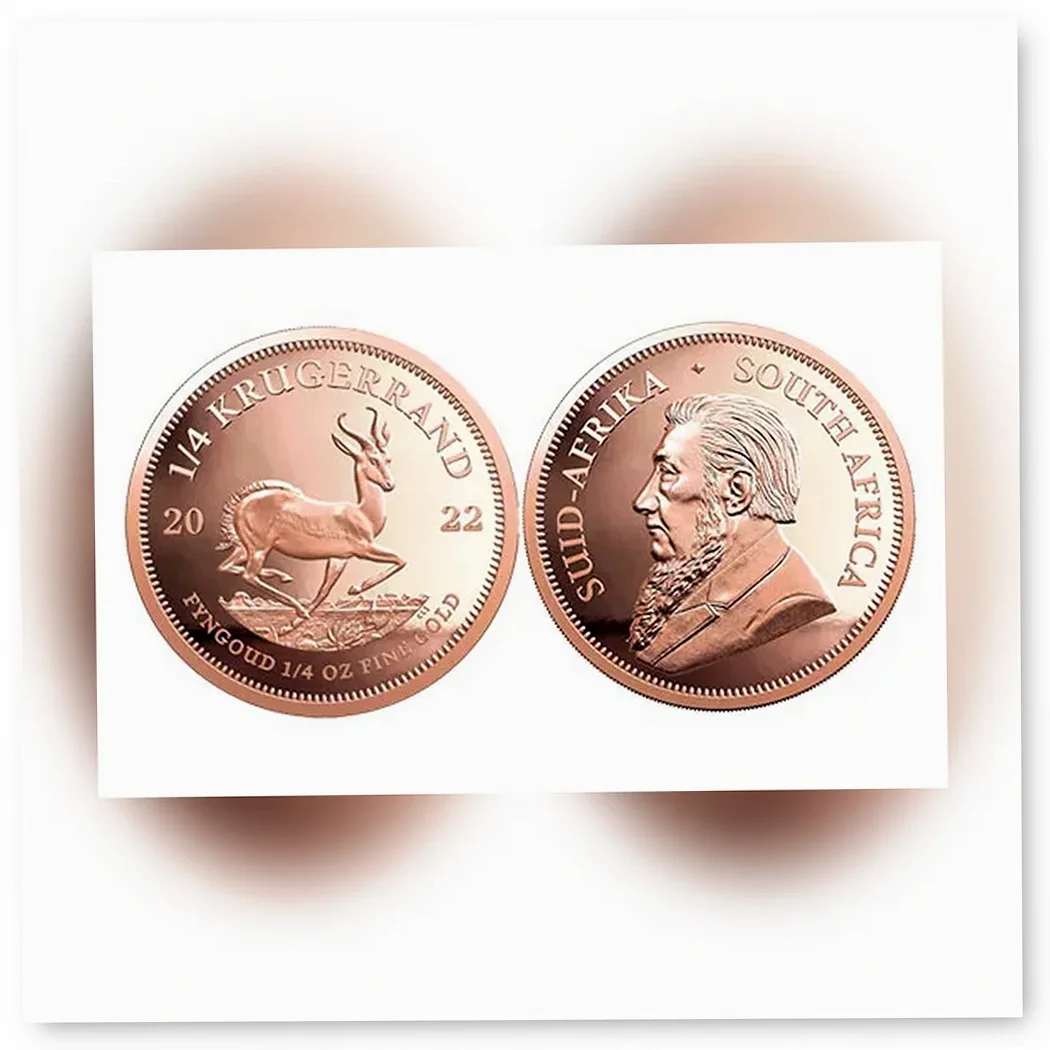

Price and Value of the Gold Krugerrand
The value of a gold Krugerrand is traditionally determined as a 'premium to spot'. This means that the price of the coin is composed of the current spot price of gold, i.e., the cost of one troy ounce, to which a premium is added. This premium typically ranges from 3% to 5%.
However, beyond the basic premium, there are other nuances that influence the determination of the exact value of each specific coin from this famous series. The short-term volatility of the physical gold market makes it impractical to state fixed prices, as they quickly become outdated.
To find out the current value of a gold Krugerrand, it is recommended to consult reliable precious metal coin dealers. They monitor the rapidly changing market daily and can provide the most up-to-date pricing information.
Origins of a Legend: A Brief History of the Krugerrand
First introduced in the late 1960s, gold South African Krugerrands made history as the first modern bullion coins. Within a decade, they quickly gained popularity, becoming the most widely sold form of gold for private ownership.
For a long time, Krugerrands held an overwhelming share of the bullion coin market, but the situation changed in the mid-1980s. During this period, international embargoes were imposed against South Africa in response to its system of racial segregation, known as apartheid.
For example, gold buyers and private investors in other countries were prohibited from purchasing Krugerrands through their Individual Retirement Accounts (IRAs). This became one of the reasons for the loss of market share.
In response to these embargoes, many countries began creating their own bullion coins to meet the demand for precious metals. Nevertheless, the Krugerrand maintains its role as a popular investment tool, offering speculators and collectors many opportunities for long-term profit.
Birth of an Icon: The Making of the Coin
The first Krugerrand was minted on July 3, 1967. Gold for the coins is supplied by Rand Refinery, and the production itself is carried out by the South African Mint. This organization is the only one in the world authorized by the South African Reserve Bank to mint Krugerrands and other South African coins that are legal tender.
Notably, Krugerrands do not have a face value like regular currency. Their value is determined solely by their precious metal content.
The name 'Krugerrand' is a fusion of two words: the surname of former President of the Republic of South Africa, Paul Kruger, whose portrait (a work by Otto Schultz) adorns the obverse of the coin, and the name of the country's monetary unit – the South African Rand. The reverse of the coin, designed by Coert Steynberg, features a leaping springbok – a type of antelope widely distributed in Southern Africa and one of the national symbols of the South African government.
Diversity of Gold Krugerrands: Sizes and Formats
The South African Mint issues four different types of gold Krugerrands, which vary in weight. It's important to note that all these coins are minted from 22-karat gold, which corresponds to 91.7% purity. To ensure the physical durability of the coin, 8.33% copper is added to the alloy.
- 1 Ounce: Since the launch of the gold Krugerrand program in 1967, the 1 troy ounce coin has been the flagship product. Until 1980, it was only available in this weight. Each such coin has a diameter of 32.77 mm, a thickness of 2.84 mm, and a gross weight of 33.93 grams.
- 1/2 Ounce: In 1980, the South African Mint began minting smaller Krugerrands. The 1/2 ounce coin allowed more people to acquire the popular Krugerrand. Such coins were typically produced in smaller editions and, in some years, were only minted as Proof.
- 1/4 Ounce: The debut of the 1/4 ounce gold Krugerrand also took place in 1980. It proved very popular due to its more affordable price.
- 1/10 Ounce: The smallest South African gold bullion coin appeared in 1980. It became one of the best-selling, attracting budget-conscious investors and becoming a favorite gold gift. For many years, 1/10 ounce Krugerrands had one of the largest mintages.
Investment (Bullion) and Collector (Proof) Krugerrands
Gold Krugerrands are issued in two main minting formats: investment (Bullion) and collector (Proof). These types differ not only in their purpose but also in some physical characteristics.
| Characteristic | Investment (Bullion) | Collector (Proof) |
| Minting Quality | UNC (Uncirculated) | Highest, Collector |
| Number of Reeds on Edge | 160 | 220 |
| Premium to Spot Price | Relatively Lower | Significant Numismatic Premium |
| Target Audience | Precious Metals Investors | Collectors, Numismatists |
| Mintage | Traditionally Significantly Higher | Traditionally Lower, but Changing in Recent Years |
Bullion UNC investment coins are primarily intended for precious metals investors. Their appeal is due to relatively lower premiums compared to Proof versions.
Gold Krugerrands in Proof quality have been minted since the program's launch in 1967 and embody the minting quality of this iconic coin. These coins differ from their investment counterparts with a special luster and detail. For decades, the South African Mint traditionally struck far fewer Proof coins, however, in recent years, as the Krugerrand has also become a numismatic symbol, the mintages of Proof coins have in some cases exceeded Bullion.
Rare Finds: Peculiarities and Errors of Krugerrands
Krugerrands are minted according to strict standards, making the discovery of error coins a relatively rare occurrence. Nevertheless, the Krugerrand series does feature coins with 'peculiarities' that can be of great value to collectors.
One of the most notable examples is the 2011 Proof gold Krugerrands with below-standard weight. An undetermined but small number of these coins had the correct overall weight but contained less gold than intended. This error was due to a change in the amount of gold in the planchets during the production process. Collectors may also find coins with other defects, such as doubled die errors or off-center strikes.
The Art of Collecting Krugerrands
In the early 1980s, Krugerrands accounted for up to 90% of all gold investment coins bought and sold worldwide. However, this figure significantly decreased due to international embargoes and the emergence of new investment coin programs, such as the American Eagle from the U.S. Mint and the Canadian Maple Leaf from the Royal Canadian Mint. With the increase in available options, many speculators diversified their portfolios.
Despite this, there are many numismatists specializing in collecting South African Krugerrands. Hundreds of interesting specimens are available to them, considering all sizes and quality types. Affluent collectors may aim to assemble one coin of each date in the series, and some go even further, acquiring both gold investment coins and Proof examples of every type of Krugerrand for each year of issue.
South Africa also issues Krugerrand investment coins in a classic design made from two other precious metals: silver and platinum. This allows collectors to diversify their investments and expand their collections with silver and platinum coins.
Frequently Asked Questions about Krugerrands
Are Krugerrands worth more than gold?
Yes, any undamaged Krugerrand will always be worth more than its intrinsic value by gold weight. On average, this premium typically ranges from 3-5% above the spot price of gold. Some Krugerrands hold significant numismatic value. For instance, a first-year issue 1967 Krugerrand can be auctioned for twice the value of its gold content, which is 100% above the spot price. Additional reasons for higher value include manufacturing costs for minting, as well as storage and shipping expenses.
How to Sell Krugerrands?
Krugerrands can be sold anywhere gold is purchased. However, the best option is to approach a reputable gold coin dealer.
Were Krugerrands illegal in the USA?
In the mid-1980s, under President Ronald Reagan, the U.S. government banned the import of gold coins from South Africa as part of sanctions against the apartheid system. This embargo also temporarily excluded some foreign coins from Americans' investment accounts. Nevertheless, simply owning these coins was not against the law, unlike the ban on private ownership of any physical gold in the States from 1933 to the mid-1970s.
When Did Krugerrands Become Legal?
Krugerrands became fully legal in 1994, with the completion of the dismantling of apartheid. After the end of the US embargo, Krugerrands could be included in individual retirement accounts (gold IRAs) regardless of their issue date, even if they were minted between 1985 and 1994.
Can You Sell Krugerrands at a Bank?
Generally, you cannot sell Krugerrands at a bank in the United States or Russia. However, in some jurisdictions, particularly in East and Central Asia, bank branches may accept them in exchange for local fiat currency.
Is Buying Krugerrands a Good Investment?
Krugerrands are primarily intended for long-term wealth preservation, so in that sense, they are certainly a good investment. As a numismatic item, Krugerrands can also become more than just a gold investment if demand in the gold coin market is high.
Which Krugerrand is the Most Expensive?
The most expensive is the 2017 50-ounce anniversary Krugerrand. It was recently valued at 2.2 million South African Rand, which was over $140,000 USD at the time of writing. The intrinsic value of this coin alone reaches an impressive $92,500, based on the current gold price. Its value as a collectible item is significantly higher due to its rarity – only 50 copies were minted.
Are Krugerrands Used in South Africa?
Due to the absence of a face value, Krugerrands have never been used as actual currency. Although many changed hands within South Africa through trade, the coins were primarily intended for export abroad to promote the growth of the South African gold and silver market. This intended purpose of Krugerrand precious metals investment coins successfully thrives globally today. For instance, in 2021, Germany imported more Krugerrands directly from South Africa than in any other year in the past three decades.
